REASON FOR CHOOSING THE TRAINING
Conventional summative evaluation practice involving the use of
before-after measurement of results provides information on the
outcomes of an intervention. Such measurement tells us nothing about
the process that connected the outputs to the inputs and therefore
provides no insights into why a particular outcome was achieved.
It is commonly presumed that simply replicating the same inputs
under similar conditions will consistently produce the same output.
But practically the next social and environmental setting will never
be exactly the same and, even if it were, intervening forces would
almost always change the outcome. So knowing only the result provides
no guidance regarding how future performance might be improved.
It is the process documentation that could help then! Process documentation
exercises greatly deepen perspectives on the context and meaning
of development action.
Otherwise too, the project implementing
personnel often lack necessary skills of documenting and reporting
their own achievements in the projects. Analyzing the situations,
the processes of interventions made and the achievements/ outputs
is difficult task for the project personnel. Training imparts skills
of preparing varied types of documents e.g. quarterly/six-monthly/
annual progress reports, annual report of organization, folder,
newsletter, poster, manual, photo book, case book, etc. It simultaneously
inculcates skills of disseminating the documented stuff in medium-friendly
way. Visual presentation of documents is central to all types of
documents. Moreover, during the implementation of development projects
various case stories and success stories generate that can not only
reveal the processes of execution but also give rise to learning.
But these stories remain undocumented due to the lack of necessary
skills at the part of organization. Training program is also to
impart skills among project executives of how to write case and
success stories.
MODULE
OF THE TRAINING
Tentative module of the training is as under:
Day.1
• Process Documentation: Theory & Practice
• Importance of Process Documentation, Reports and Dissemination
of Results
• What should be documented and why?
• Types of Documents and Reports of NGOs/ Development Projects
• General Techniques of Documentation and Communication
• Laying the Foundation
• Making Plan for Documenting and Communicating a Product
• Techniques of Writing Quarterly/ Annual Progress Report
of a Project/ Organization
Day.2
• Techniques of Writing Annual Report of Organization
• Techniques of Writing Study Reports
• Techniques of Preparation of Brochure of Organization
Day.3
• Techniques of Good Presentation of Documents/ Reports
• Demonstration of Making Good Documents on Computer
• Power Point Presentations
• Photography and Photo Documentation
• Video Documentation: Steps of Pre-Production, Production
and Post-Production Phases
Day.4
• Importance of Case Story in Process Documentation
• Difference between Case Story and Case Study
• Techniques of Case Story Writing
• Photo Presentation with Case Story
Day.5
• Outreach Tools
• Techniques of Dissemination of Documented Information
• 20 Ways of Communicating the Results/ Organization
PLACE
OF THE TRAINING & ACCOMMODATION
Regional Research Station
H. P. Agriculture University
Bajaura, Kullu - 175 121 (HP)
* accommodation is moderately furnished.
WHO
CAN PARTICIPATE THE TRAINING?
NGO or Government executives who are involved in field implementation
and or documentation of development projects should apply on prescribed
Application Form. The training is exclusively for field executives.
Therefore, the applicants should keep this fact in consideration
when applying. Interested potential participants should submit their
Application Form by post along with specified Fee before the deadline.
LEARNING STRATEGY & FEATURES
• Experienced 'Resource Persons'
• Substantive reflections of participants' own personal capacities
• Group deliberation and experiential activities
• Handouts and reading materials
• Visuals and pictorials
• Residential venue and learning practice without formal time
limits
CONTRIBUTION
TOWARDS THE COST
Contribution of Rs 5000 per participant is expected to be paid in
advance. DD should be made in favour of GRASSROOTS INDIA payable
at New Delhi.
Contribution
is towards the cost of moderate accommodation and hygienic food,
which will be provided during 5 day of training. However, the travel
expenses to Kullu and back would be taken care of by the participant
or sponsoring organization.
MEDIUM
OF THE TRAINING
The medium of instructions will be mix of Hindi and English. Those
who are engaged in projects execution in field and undertake documentation
will benefit more.
LAST
DATE OF REGISTRATION
15 April 2008. Early applicants will be given priority.
AVAILABILITY
OF PLACES
The training program has vacancies for 25 persons only. The places
will be booked on first come first served basis.
HOW
TO REGISTER?
There is a specified Application Form for registration, which is
attached with this Brochure. Please fill in the Application Form
and post it with the DD for Rs. 5000 as your Contribution. Registration
will be done on receipt of Fees only. When you post the application,
kindly confirm with us by phone or e-mail too; though we'll acknowledge
immediately after receipt of your application.
HOW
TO REACH THE PLACE OF TRAINING?
Best way to reach the place of training is to catch bus from Delhi.
Regular buses are available from ISBT Kashmere Gate in Delhi to
Kullu or Manali. Buses are of several types: ordinary state buses,
semi-deluxe state buses, deluxe state buses, deluxe luxury buses,
sleeper buses, or Volvo buses. One can get buses from Chandigarh
also. From the bus one has to get down at Bajaura, several kilometres
before Kullu city. Place of training is the best area to live and
located on Beas river bank. After the training, one can visit best
tourist places of the country. Please note that it is better to
book buses well in advance due to heavy rush in summer season.
WHERE
TO CONTACT OR APPLY?
Interested people may contact or send their Application Form with
DD of Contribution by post to:
Mr. Chuni Lal
Grassroots Institute
SHARA, Top Floor, PO Building
Banjar - 175 123 Kullu (HP)
Tel: 01903-222304, 201201, 09418133427
E-mail: grassrootsinstitute@gmail.com
Website: www.grassrootsglobal.net/gi
OR
Ms. S. Haleem
Grassroots India Trust
1st Fl, 50A, Street 17, Zakir Nagar, Okhla
Opp. New Friends Colony A-Block
New Delhi - 110 025 India
Tel: 011-26955452, 09868993710 Fax: +91-11-26936366
E-mail: grassrootsindia@rediffmail.com
Website: www.grassroots.org.in
DOWNLAOD
TRAINING BROCHURE
-----------------------------------------------------------------------------------------------------------------------------------------------------------------
Report of IVth Training 2007
A
5-day training, organized jointly Grassroots Institute and Grassroots
India Trust, was held at Parshawnath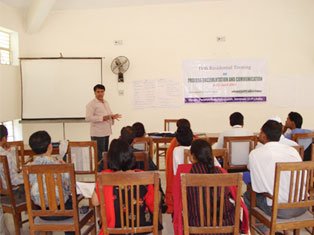 Vidyapeeth (an affiliated research centre of Banaras Hindu University).
In the training important topics taught were: Process Documentation:
Theory & Practice; What should be documented and why; Types
of Documents and Reports of NGOs/Development Projects; General Techniques
of Documentation and Communication; Techniques of Writing Quarterly/
Annual Progress Report of a Project/ Organization; Techniques of
Writing Annual Report of Organization; Techniques of Writing Study
Reports; Techniques of Preparation of Leaflet/ Folder of Organization;
Techniques of Good Presentation of Documents/ Reports; Demonstration
of Making Good Documents on Computer; Power Point Presentations;
Photography and Photo Documentation; Video Documentation: Steps
of Pre-Production, Production and Post-Production Phases; Importance
of Case Story in Process Documentation; Difference between Case
Story and Case Study; Techniques of Case Story Writing; Photo Presentation
with Case Story; Outreach Tools;
Vidyapeeth (an affiliated research centre of Banaras Hindu University).
In the training important topics taught were: Process Documentation:
Theory & Practice; What should be documented and why; Types
of Documents and Reports of NGOs/Development Projects; General Techniques
of Documentation and Communication; Techniques of Writing Quarterly/
Annual Progress Report of a Project/ Organization; Techniques of
Writing Annual Report of Organization; Techniques of Writing Study
Reports; Techniques of Preparation of Leaflet/ Folder of Organization;
Techniques of Good Presentation of Documents/ Reports; Demonstration
of Making Good Documents on Computer; Power Point Presentations;
Photography and Photo Documentation; Video Documentation: Steps
of Pre-Production, Production and Post-Production Phases; Importance
of Case Story in Process Documentation; Difference between Case
Story and Case Study; Techniques of Case Story Writing; Photo Presentation
with Case Story; Outreach Tools;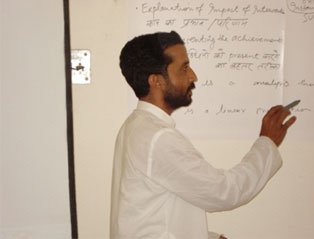 Techniques of Dissemination of Documented Information; and 20 Ways
of Communicating the Results/ Organization.
Techniques of Dissemination of Documented Information; and 20 Ways
of Communicating the Results/ Organization.
The participants came from the following organizations: ICIMOD,
Kathmandu; Guria, Varanasi; Gene Campaign, New Delhi; Akshay Pratishthan,
New Delhi; Adivasi Sevasharm Trust, Indore; SAATHI, Chennai; MITTRA,
Nasik; Centre for Environment Education, Lucknow; SHARA, Kullu;
PARA, Mandi; Navjyoti Development Society, Delhi; YASHADA, Pune;
CREATE, Lucknow; Nav Bhartiya Nari Vikas Samiti, Ballia. The training
was facilitated by Mr. Hasrat Arjjumend, Mr. Kamlesh and Mr. Ashendra
Singh. The feedback of the participants was very appreciating, as
they found the training useful, skill-enhancing and momentous.
|