BACKGROUND
Participatory planning is a process by which a community undertakes
to reach a given socio-economic goal by consciously diagnosing its
problems and charting a course of action to resolve those problems.
Experts are needed, but only as facilitators. Moreover, no one likes
to participate in something which is not of his/her own creation.
Plans prepared by outside experts, irrespective of their technical
soundness, cannot inspire the people to participate in their implementation.
The participatory
planning process has implications for the working methods of a
conventional local development planner. Current decentralized
planning techniques often keep people out of the planning process,
which severely limits their ability to deliver the intended results
at local level and reinforces the centralizing tendencies in decision-making.
The basic issue of whether people or planning techniques should
be changed first, has not yet been answered. As a facilitator
of local change, the development planner will have to shed much
of the planning jargon and simplify his/her planning techniques
so that these are widely understood.
This training
is for those who design and manage community-based development
programs or projects, and extension officers and field personnel
that implement them. Participants are meaningfully engaged to
reflect on the practical applications of PPME within the context
of their own organization, program, or project; and to identify
ways to improve their current practices in planning, monitoring
and evaluation. The training focuses on how to design and institutionalize
Participatory Planning and M&E systems in projects and programs
for continuous learning and enhanced performance.
OBJECTIVES
OF THE TRAINING
• To sharpen the skills of project managers, NGO heads,
government executives or alike on ‘participatory planning,
monitoring and evaluation’; and
•
To develop professional competence of participatory planning processes
and M&E system among the project managers and field executives
especially belonging to development sector.
VENUE
OF THE TRAINING
Hotel
Shobla International
Dhalpur, Kullu (Himachal Pradesh) – 175 101
Tel: +91 (01902) 222800, 222801
Email: info@shobla.com
Website: www.shoblainternational.com
MEDIUM OF THE TRAINING
The medium of instructions will be mainly English. Participants
can speak and write in English, Hindi or Urdu. Those who are engaged
in projects planning in the field and execute the projects will
benefit more.
LEARNING
STRATEGY & FEATURES
• Participatory learning methodologies
• Substantive reflections of participants' own personal capacities
• Group deliberation and experiential activities
• Handouts and reading materials
• Visuals and pictorials
• Residential venue and learning practice without formal time
limits
LAST
DATE OF REGISTRATION
Deadline for Application: 31 August 2008
Deadline for Fee Receipt: 10 September 2008
Early
applications will be given priority. The moment the seats are full,
accepting further applications will be stopped. Applicants whose
fee is received will only be confirmed with the places.
AVAILABILITY
OF PLACES
Total no. of seats: 25
The
places will be filled on first come first served basis.
MODULE
OF THE TRAINING
Tentative module of the training is as under:
Day.1
Participatory Planning
• Conceptual Building Blocks and Core Principles of PPM&E
• Fundamentals of Facilitating Learning & Participatory
Processes
• How to Identify Needs and Opportunities with the Stakeholders
• Designing Comprehensive and Feasible Project Strategies
Day.2
Participatory M & E Processes
• Principles of Participatory and Learning-Orientated Planning,
Monitoring and Evaluation
• Choosing Appropriate Indicators and Performance Questions
• Designing Comprehensive and Feasible M&E Systems
• Assessing the Necessary Conditions and Capacities for Participatory
M&E Processes
• How to Manage the Impact of Participatory M&E Processes
• Field Visit for Practical Exercise
Day.3
• Group Presentations of Practical Exercise
Institutionalizing
Participatory Processes and Learning
• Building Organizational Support for PPM&E
• Planning to Make a Difference – developing own action
plan
• Creating a Learning Environment in Teams and Organizations
Day.4
• Assessing the Impact of the Project / Program/ Organization
• Participatory Organizational Evaluation: steps and methodology
• Issues and challenges in participatory monitoring and evaluation
*
The module is subject to change. A cultural program will also be
organized during the tenure of training.
ELIGIBILITY
TO PARTICIPATE THE TRAINING
You
are eligible if you fulfill the following criteria:
(i)
Your education is minimum Graduate;
(ii) You manage or coordinate the development action while serving
an NGO, support agency or government project;
(iii) You have at least 2 years of field experience;
(iv) You have adequate knowledge of English language;
(v) Your application is approved by your Head of Institution; and
(vi) You agree to follow the rules of participating the training
and sign the declaration (given in application form).
ACCOMODATION
& LOGISTICS
Place
of training, Hotel Shobla International, is one of the nicest locations
in sacred city of Kullu. It is located in city heart called Dhaalpur
where all buses stop and taxi stand exists. Famous Dassehra ground
is in vicinity apart from the government offices.
Participants
will be provided with the accommodation on TWIN SHARED basis. Rooms
are equipped with linen, quilt, chair, table, attached toilet-bath,
color TV, etc. Daily cleaning of rooms is ensured.
Water
supply is generally adequate in the hotel. However, the possibility
of occasional interruption in water supply cannot be ruled out,
viewing the scarcity of water in the mountains. Electricity supply
is plenty.
Accommodation
for participants will be available from 5 pm of 21st September’08
till 5 pm of 25th September’08. Before or after this duration,
the accommodation will not be availed by the organizers. Residing
in Hotel Shobla International before or after the specified timings
will be the responsibility participant at his/her own cost.
To see
the glimpses of Hotel
Shobla International, please look at the photographs
or visit the Hotel's website.
FOOD & REFRESHMENTS
During
the training vegetarian food will be served. On 21st September’08,
the dinner will be served. From 22nd September till 25th September,
a bed tea, breakfast, lunch and dinner will be served everyday.
No dinner will be served on 25th September. Tea will be served twice
during 4 days of the training during sessions.
TRAINING FEE
For Indian Participants
A
non-refundable fee of Rs. 10000 per participant is to be paid through
DD once the Application is approved. DD should be made in favour
of GRASSROOTS INDIA TRUST payable at New Delhi. Receipt for fee
amount will be produced.
The
fee can also be deposited by cash/local cheque in the account of
GRASSROOTS INDIA TRUST. The account details can be obtained from
Coordinator Training before depositing the fee.
Above nominal fee is towards the cost of (i) accommodation, (ii)
food, (iii) reading material kit, (iv) CD-ROM (to be provided at
the end of training), (v) organizing the field visit for practical
exercise, (vi) organizing the cultural program, and (vii) general
guidance.
For
Foreign Participants
A
non-refundable fee of INR 15000 per participant is to be paid through
DD once the Application is approved. DD should be made in favour
of GRASSROOTS INDIA TRUST payable at New Delhi. Receipt for fee
amount will be produced.
Above
nominal fee is towards the cost of (i) accommodation, (ii) food,
(iii) reading material kit, (iv) CD-ROM (to be provided at the end
of training), (v) release of official offer letter to facilitate
visa process, (vi) organizing the field visit for practical exercise,
(vii) organizing the cultural program, and (viii) general guidance.
HOW
TO APPLY AND REGISTER ?
Step-I:
Applicants should fill in the Application Form which is attached
separately or can be downloaded from www.grassroots.org.in/catalogue/ppme_application_form.doc,
and submit it by e-mail grassrootsinstitute@gmail.com
quickly to the Grassroots Institute. In case of difficulty, one
can request Application Form through e-mail.
Step-II:
If the applicant is found eligible, he/she will be immediately informed
and asked to send the amount of requisite fee through Demand Draft
drawn in favour of Grassroots India Trust payable at New Delhi.
Along with the payment, the applicant should also send the hard
copy of Application Form duly approved by the Head of Institution
and signed by the applicant himself/herself. The DD is to be sent
by SPEEDPOST or AIRMAIL to: Mrs. S. Haleem, Administrator,
Grassroots India Trust, 301 H-51/E, A. F. Enclave, Okhla, New Delhi
– 110 025 India.
Step-III:
After dispatching the DD and hard copy of the Application Form,
the applicant is expected to inform Mr. Chuni Lal at Grassroots
Institute on his mobile telephone (+91-9418133427).
*
Please note that the candidature for this training in non-transferable.
No other candidate would be accepted in place of the applicant.
TRAVEL
& TRANSPORT EXPENSES
The
travel and transport expenses to Kullu (and venue of training) and
back would be taken care of by the participant or sponsoring organization.
The organizers will not be responsible for any travel or transport
expenses and or arrangements. Applicant is required to make his/her
own bookings etc. Moreover, the organizers cannot arrange for receiving
the participants at Bus Stand or Airport of Kullu. It will be the
responsibility of the participants to reach the venue of training.
HOW
TO REACH THE PLACE OF TRAINING ?
There
is no train route to Kullu. However, the trains go upto Chandigarh.
You can reserve your rail tickets through your booking agent or
by visiting: http://indianrail.gov.in/ .
Best
way to reach the place of training is to catch bus from Delhi. Regular
buses are available from ISBT Kashmere Gate in Delhi to Kullu-Manali.
Buses are of several types: ordinary state buses, semi-deluxe state
buses, deluxe state buses, deluxe luxury buses, or Volvo buses.
One can get buses from Chandigarh also. From the bus one has to
get down at Dhalpur (Kullu). Please note that it is better to book
buses well in advance due to rush of tourists.
Bookings
for different modes of transport may be made by contacting the following:
||
Bus from Delhi to Kullu (13 hours journey)
HP Tourism: +91-11-23325320, 23324764
TCIL: +91-11-23416081-85, 23418023
||
Bus from Chandigarh to Kullu (8 hours journey)
*all types of buses are frequently available from Sector-17 Bust
Station in Chandigarh (no need of reservation)
|| Flight Connectivity
Various domestic flights are available to Kullu. Kullu airport is
located in Bhutar which is 4-5 km away from main Kullu city. Please
see the schedule of flights at the link: http://wikitravel.org/en/Kullu
and http://wikitravel.org/en/Manali
. Indian Airlines, Deccan Air and Jagson Airlines operate from Delhi
and Chandigarh to Bhuntar (Kullu)
*Reserve
your return ticket from your travel agent in your city/town.
How to Reach the Venue?
The
Hotel Shobla International is right at Dhalpur in Kullu. On reaching
Dhalpur in Kullu, anybody can guide to reach the hotel.
ABOUT
THE GRASSROOTS INSTITUTE
Grassroots
institute aims to strengthen the grassroots action for social transformation
through mainstreaming innovative learnings. Grassroots Institute
is established by Grassroots India Trust (No. UA/972, registered
under M. P. Public Trust Act 1951) to support the grassroots action
for change through training, research, skill upgradation and professional
education. Presently, the Grassroots Institute is in evolution phase
and is being operated from Banjar (Kullu) in Himachal Pradesh. For
further information about the GI, please visit the links: www.grassrootsinstitute.in,
www.grassrootsglobal.net/gi.
CONTACT
FOR GENERAL ENQUIRY
MR.
CHUNI LAL
Coordinator Training
Grassroots Institute
GIT/SHARA, Top Floor, PO Building
Banjar - 175 123 Kullu (HP), India
Tel: +91-1903-201201, 222803, +91-9418133427
E-mail: grassrootsinstitute@gmail.com
Websites: www.grassrootsinstitute.in
www.grassrootsglobal.net/gi
www.grassroots.org.in
TOURIST
ATTRACTIONS OF KULLU & MANALI
Manali is hot destination for tourists as it lies on silk
route going to Ladakh and Hindukush-Himalayas connecting the Central
Asia. There are more than two dozens of attractions in Manali and
Kullu for the tourists. Further information can be accessed from
the following websites:
http://wikitravel.org/en/manali
http://himachaltourism.nic.in/kulu.htm
http://www.touristplacesinindia.com/manali/tourist-attractions.html
http://himachaltourism.nic.in/shim.htm
http://himachaltourist.com/shimla/index.htm
www.greathimalayannationalpark.com
DOWNLOAD
APPLICATION FORM
IMPORTANT
ANNOUNCEMENT
Certificate Course in Organic Agriculture
(CertOA) - 3 months
The
Grassroots Institute is launching CertOA course from October
2, 2008 through Distance Education. The course is designed
keeping in view the needs of working professionals as well
as students who wish to build their perspective and sharpen
skills on organic agriculture.
Further
information can be obtained from Grassroots Institute: grassrootsinstitute@gmail.com
|
Progress
of our past trainings on may be seen by visiting the link: www.grassroots.org.in/trainings_progress.htm
-----------------------------------------------------------------------------------------------------------------------------------------------------------------
PROFILE
OF TRAINING FACILITATORS
 Mr.
Ninan Oommen is a Post Graduate in Social Work and Sociology
and worked with William Carey Study & Research Center, Pragna
Research & Consultancy Services, Special Olympics Bharat, New
Delhi, YCYD, CAPART (Ministry of Rural Development), WWF-India,
HelpAge India, Christian Children Fund and USAID from 1973 to 2006.
Specialized in Program and Project Management, Knowledge Management,
Monitoring & Evaluation with professional experience covering
social research and surveys, applied social development (e.g. gender,
social security strategies, education and health etc.), participatory
approaches to rural development and management, community resource
management, capacity building through support to local authorities
and service providers, inter-linking government agencies to civil
society organizations and NGOs, development of appropriate strategies
and methodologies at the institutional and grassroots level for
ensuring sustainability, and management of programs. He is former
President of Y’s Men International and current member of various
Program Committees of New Delhi YMCA. He is currently the Guest
Faculty member of the Institute of Management Studies at YMCA, and
Chair-designate of Grassroots India Trust. Mr.
Ninan Oommen is a Post Graduate in Social Work and Sociology
and worked with William Carey Study & Research Center, Pragna
Research & Consultancy Services, Special Olympics Bharat, New
Delhi, YCYD, CAPART (Ministry of Rural Development), WWF-India,
HelpAge India, Christian Children Fund and USAID from 1973 to 2006.
Specialized in Program and Project Management, Knowledge Management,
Monitoring & Evaluation with professional experience covering
social research and surveys, applied social development (e.g. gender,
social security strategies, education and health etc.), participatory
approaches to rural development and management, community resource
management, capacity building through support to local authorities
and service providers, inter-linking government agencies to civil
society organizations and NGOs, development of appropriate strategies
and methodologies at the institutional and grassroots level for
ensuring sustainability, and management of programs. He is former
President of Y’s Men International and current member of various
Program Committees of New Delhi YMCA. He is currently the Guest
Faculty member of the Institute of Management Studies at YMCA, and
Chair-designate of Grassroots India Trust.
|



























 Mr.
H. Arjjumend attained
MSc from G. B. Pant University of Agri. & Tech. in Environmental
Science, MRM from Indian Institute of Forest Management (Govt. of
India) and few certificate courses from World Bank Institute, Human
Rights Education Associates (USA), Green Net (Thailand), Grolink
(Sweden) and Transcend University (Belgium). He was Commonwealth
Professional Fellow 2007 in Wolverhampton/London. Currently he is
Social-Impact Fellow. He has over 16 years experience of development
action, research, documentation and media writing. Previously he
was Biologist at Wildlife Institute of India (Govt. of India), Research
Officer at NCHSE, CCV Fellow of WWF-India, and Sr. Program Officer
at PRIA. He taught at Masters level for about 3 years in MC National
University of Journalism, Bhopal. He founded People’s Resource
Centre, a consultancy and publication group, in 1999, and served
as Consultant to large number of NGOs, support agencies and donors.
He is founder of Grassroots India Trust. He has supervised about
25 study projects and produced over 30 research/discussion papers
and technical reports. He has written over 270 project proposals
for variety of agencies/clients. He is engaged in several social
enterprises. He is the Managing Trustee and Executive Director of
Grassroots India Trust, and leading the establishment process of
all other institutions of Grassroots Group including Grassroots
Institute.
Mr.
H. Arjjumend attained
MSc from G. B. Pant University of Agri. & Tech. in Environmental
Science, MRM from Indian Institute of Forest Management (Govt. of
India) and few certificate courses from World Bank Institute, Human
Rights Education Associates (USA), Green Net (Thailand), Grolink
(Sweden) and Transcend University (Belgium). He was Commonwealth
Professional Fellow 2007 in Wolverhampton/London. Currently he is
Social-Impact Fellow. He has over 16 years experience of development
action, research, documentation and media writing. Previously he
was Biologist at Wildlife Institute of India (Govt. of India), Research
Officer at NCHSE, CCV Fellow of WWF-India, and Sr. Program Officer
at PRIA. He taught at Masters level for about 3 years in MC National
University of Journalism, Bhopal. He founded People’s Resource
Centre, a consultancy and publication group, in 1999, and served
as Consultant to large number of NGOs, support agencies and donors.
He is founder of Grassroots India Trust. He has supervised about
25 study projects and produced over 30 research/discussion papers
and technical reports. He has written over 270 project proposals
for variety of agencies/clients. He is engaged in several social
enterprises. He is the Managing Trustee and Executive Director of
Grassroots India Trust, and leading the establishment process of
all other institutions of Grassroots Group including Grassroots
Institute.  Dr.
Soma Bhowmick is currently the Program Manager at Impulse
NGO Network, Shillong, Meghalaya with specializations in Project
Designing and Consultancy, Research and Documentation on Child Rights
Issues, Human Rights, Human Trafficking, HIV/ AIDS. Significantly
experienced in educational, social and development sector for nearly
15 years, she has worked as Program Coordinator with Medecins Sans
Frontieres – Holland extensively in post–conflict situations.
She is a PhD in Public Administration, a Law Graduate and a Trained
Teacher and a Trainer of Trainers. Additionally, she possesses considerable
computer expertise and a strong background in Peace and Conflict
Studies and Human Resource Management. She has been involved in
project planning, project implementation, training, evaluation as
well as research and documentation of projects funded by Medecins
Sans Frontieres International, US Department of State through UNODC,
UNIFEM, UNICEF, USAID, UNAIDS, Tear Fund UK, MEMISA-France, etc.
Dr.
Soma Bhowmick is currently the Program Manager at Impulse
NGO Network, Shillong, Meghalaya with specializations in Project
Designing and Consultancy, Research and Documentation on Child Rights
Issues, Human Rights, Human Trafficking, HIV/ AIDS. Significantly
experienced in educational, social and development sector for nearly
15 years, she has worked as Program Coordinator with Medecins Sans
Frontieres – Holland extensively in post–conflict situations.
She is a PhD in Public Administration, a Law Graduate and a Trained
Teacher and a Trainer of Trainers. Additionally, she possesses considerable
computer expertise and a strong background in Peace and Conflict
Studies and Human Resource Management. She has been involved in
project planning, project implementation, training, evaluation as
well as research and documentation of projects funded by Medecins
Sans Frontieres International, US Department of State through UNODC,
UNIFEM, UNICEF, USAID, UNAIDS, Tear Fund UK, MEMISA-France, etc.
 Mr.
Milind Saxena is a development professional having more
than 16 years of working experience with renowned organizations
like Water & Sanitation Program – South Asia, UNICEF,
NIPFP, IEG, DFID-PACS, IDS-Knowledge Link Research Project, Water
Aid, etc. He possesses an MPhil degree in Social Medicine and Community
Health from Jawaharlal Nehru University. His areas of expertise
are health economics, environmental policy, water & sanitation,
knowledge management. He is known consultant in the field of water
and sanitation.
Mr.
Milind Saxena is a development professional having more
than 16 years of working experience with renowned organizations
like Water & Sanitation Program – South Asia, UNICEF,
NIPFP, IEG, DFID-PACS, IDS-Knowledge Link Research Project, Water
Aid, etc. He possesses an MPhil degree in Social Medicine and Community
Health from Jawaharlal Nehru University. His areas of expertise
are health economics, environmental policy, water & sanitation,
knowledge management. He is known consultant in the field of water
and sanitation. 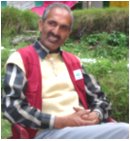 Mr.
Chuni Lal graduated from H. P. University. After serving
in army for 22 years, he established models of sustainable agriculture
on his lands. Being a progressive and technologically-appropriate
farmer, he received a number of prizes from HP Agriculture University
and Department of Agriculture. He co-founded Institute of Resource
& Environmental Management (IREM). He attained large number
of trainings from Indian Institute of Forest Management, H.P.
Agriculture University, Y.S. Parmar University of Horticulture
& Forestry, H.P. Department of Agriculture, Navdanya, Nirantar,
Grassroots Institute, HPMC, H.P. Health Department, and so on.
He is presently leading a grassroots movement of conserving the
agro-biodiversity in situ and popularizing the organic farming
practices among the peasants of Western Himalayas. Apart from
a leader of garlic cooperatives in Seraj Valley, he is known social
worker in Kullu district. He is currently the Head of Regional
Operations of Grassroots India Trust. He is also one of the Trustees
of Grassroots India Trust.
Mr.
Chuni Lal graduated from H. P. University. After serving
in army for 22 years, he established models of sustainable agriculture
on his lands. Being a progressive and technologically-appropriate
farmer, he received a number of prizes from HP Agriculture University
and Department of Agriculture. He co-founded Institute of Resource
& Environmental Management (IREM). He attained large number
of trainings from Indian Institute of Forest Management, H.P.
Agriculture University, Y.S. Parmar University of Horticulture
& Forestry, H.P. Department of Agriculture, Navdanya, Nirantar,
Grassroots Institute, HPMC, H.P. Health Department, and so on.
He is presently leading a grassroots movement of conserving the
agro-biodiversity in situ and popularizing the organic farming
practices among the peasants of Western Himalayas. Apart from
a leader of garlic cooperatives in Seraj Valley, he is known social
worker in Kullu district. He is currently the Head of Regional
Operations of Grassroots India Trust. He is also one of the Trustees
of Grassroots India Trust.