|
 |
| |
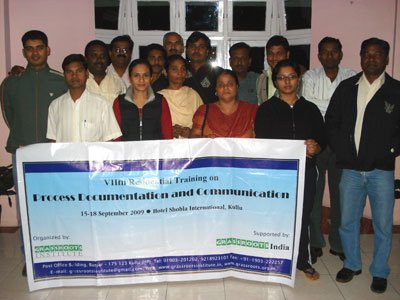
VIIth Residential Training on
PROCESS DOCUMENTATION & COMMUNICATION
15-18 September 2009 || Hotel Shobla International, Kullu (HP)
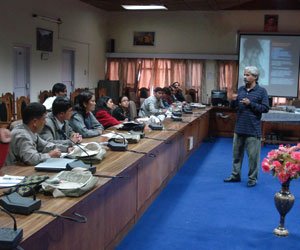
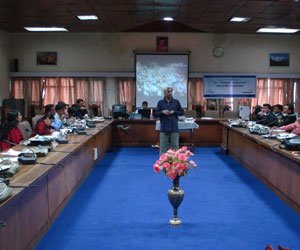
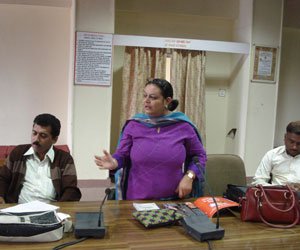
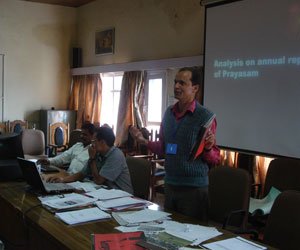
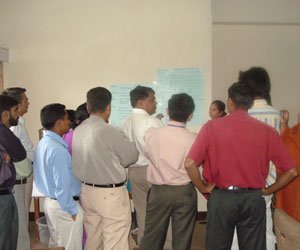
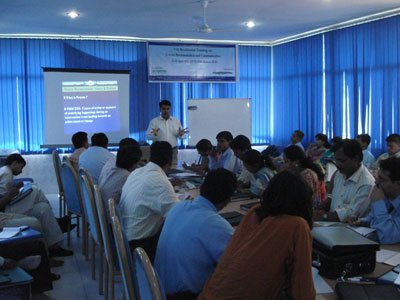
A majority of development projects implemented by NGOs, government agencies and bilateral or multilateral donors lack the mechanism of capturing the process and documenting it during the implementation of the project activities/interventions. As a result almost all valuable information and knowledge about the processes that had happened during implementation and the subsequent learning/experience are lost forever. This very hard reality was evidenced and witnessed by all the participants of the training program on the first day. Hence the need of the training was reinforced by the participants.
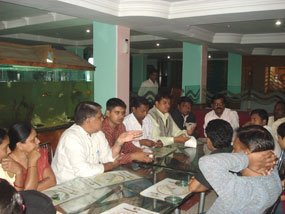
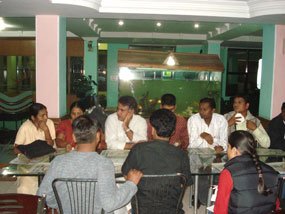
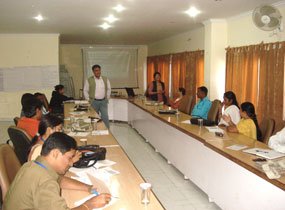
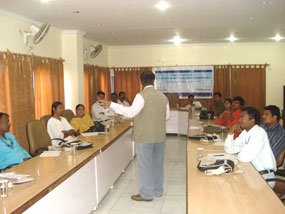
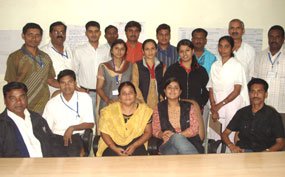
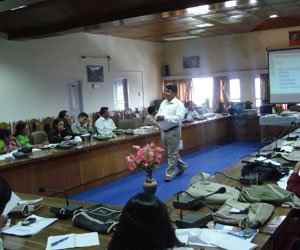
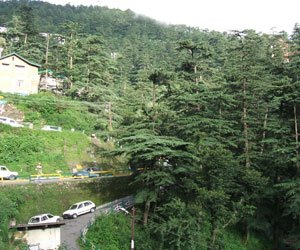
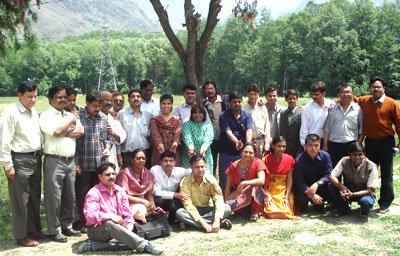
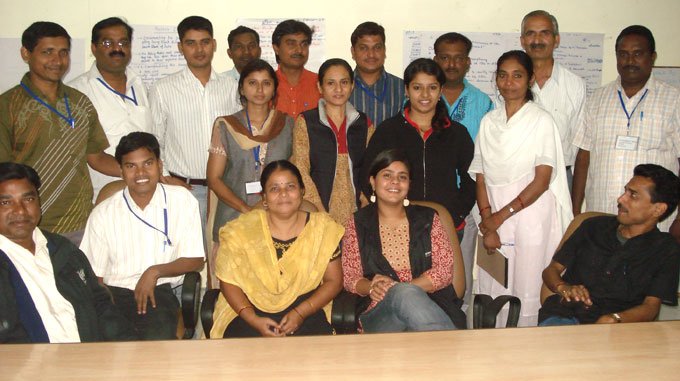
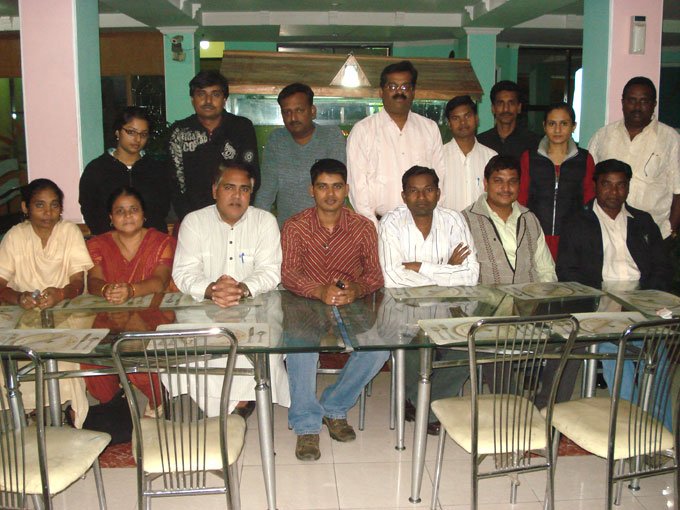
The VIIth batch of the training received adequate response from all over India. The training was conducted in magnificent Hotel Shobla International in tourism heaven of Himalayas. The participants liked the accommodation, facilities and services accessed by them during 4 days of training. They had enjoyed the deliciousness of the food and delicacy of the hotel logistics. For all the people it was incredible experience.
The session wise brief of the proceedings is given as below.
DAY.1.SESSION – I: (i) 10.00 am to 12:00 pm (ii) 12:15 pm to 1.30 pm
Welcome
Mr. Chuni Lal, the Coordinator Trainings, welcomed all the participants. The training could start bit late from the scheduled time.
Introduction
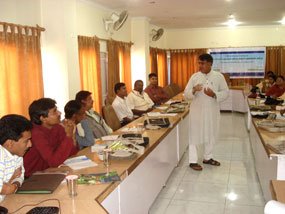
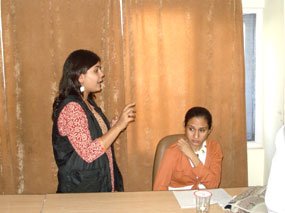
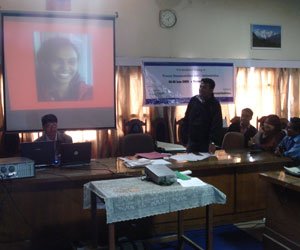
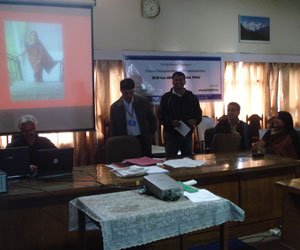
Mr. Hasrat Arjjumend, the chief trainer, gave introduction of all 3 resource persons following the briefing about the Grassroots India and its capacity building arm the Grassroots Institute. He described the background and objective of the training and its evolution. Thereafter, Ms. Pallavi Upadhyaya introduced herself in detail and explained the methodology of the proceedings of the training to be pursued during 4 days time. Mr. Chuni Lal illustrated the logistics, accommodation and food available in the hotel.
Parichaya
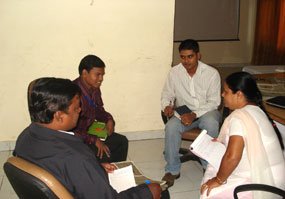
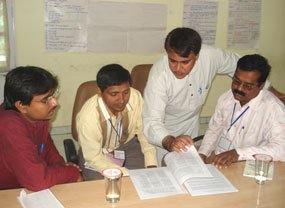
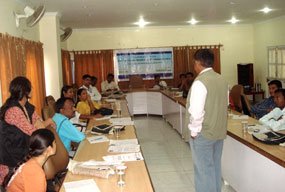
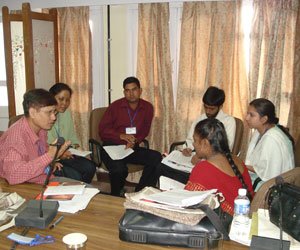
All the participants were guided to just speak their name and organization, so they did. Quickly after that instant parichaya, the participants were advised to divide into 4 peer groups. The task given to them was to know 5 salient qualities of each of the person in the peer group. The purpose of the group exercise was to make the participants familiar with their co-participants.
Process Documentation: Theory & Practice
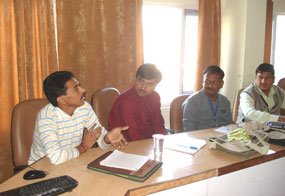
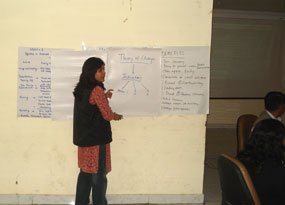
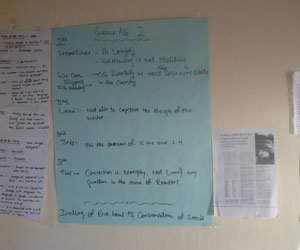
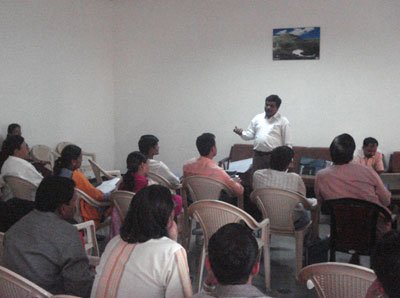
This post-tea session was started with the opening of the dais for the participants and letting them share their opinions on the process documentation. The suggested points were recorded on the chart by resource person Ms. Pallavi. Thereafter, the theoretical part of the “process” and the “documentation” started. One more exercise was also conducted before the lunch time. Gradually the participants developed clarity about the concepts of ‘process documentation’.
DAY.1.SESSION – II: (i) 2.30 pm to 4.00 pm (ii) 4.30 pm to 6.00 pm
Process Documentation: Theory & Practice
After the lunch the lecture as well as group exercises continued. Till the tea break at 4 pm, the participants were pretty clear about the theoretical and practical aspects of the process documentation being applied in the project management. They also revealed their weaknesses and gaps in the work of documentation.
Importance of Process Documentation
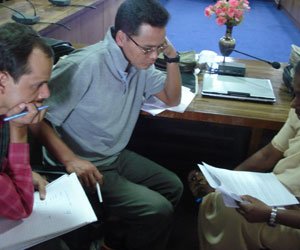
Within the peer groups the participants identified varied types of merits of the process documentation in the project works. The participants were surprised when they found the demerits of the process documentation. |
DAY.2.SESSION – III: (i) 9.30 am to 11.00 am (ii) 11.30 am to 1.00 pm
How to document the process?
The methodology and tools to document the processes were critical components of the training after getting the participants understand the concepts. There followed a group discussion on various methods and tools to capture the processes, collating and organizing the gathered data/information, and analysis of the information.
Characteristics of Documentation Specialist
There was a brief lecture on the characteristics of the documentalist. Being an external or from inside the project a documentalist should have certain qualities to capture the processes without bias and without a miss.
Planning of Process Documentation
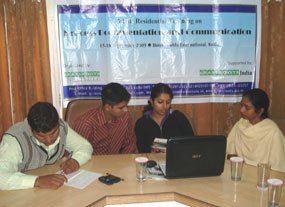
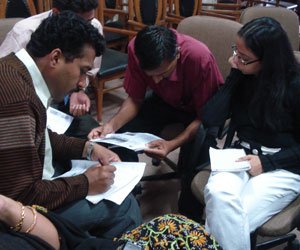
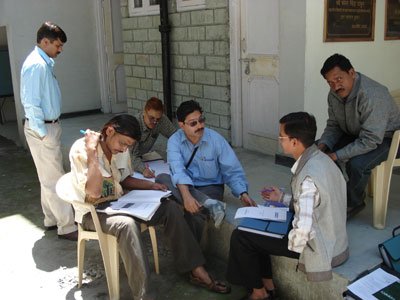
All the participants were divided as per their corresponding organizations. The groups of 7 participants from OTELP project of Orissa were divided into 2 different groups. Two participants from Vanangna were grouped together. Rest of the participants worked individually on the grand exercise of planning a process documentation of their respective project(s).
DAY.2.SESSION – IV: (i) 2.00 pm to 3.30 pm (ii) 4.00 pm to 5.30 pm
Planning of Process Documentation
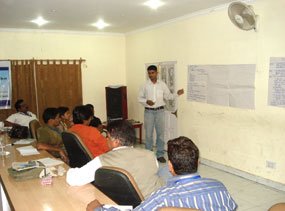
The exercise continued till 4 pm. Thereafter the presentations started that continued till 8:30 pm. |
DAY.3.SESSION – V: (i) 9.30 am to 11.00 am (ii) 11.30 am to 1.00 pm
Case Story/Study
After clarifying the meaning and definitions of ‘case story’ and ‘case study’ and the differentiation between the two (with demonstrations), the lecture elaborated the ‘case’ and continued to emphasize on the practices in the development sector. The participants were demonstrated the samples of the case stories and case study.
Techniques of Case Story Writing
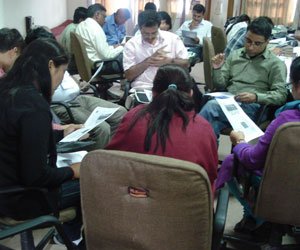
Lecture elaborated the theoretical aspects of Case Story writing. Practical examples were described. Then the participants did an exercise of analysing different sets of published case stories. The groups of the participants later shared openly their observations made during the analysis exercise. The exercise was revealing for everyone as the participants had clear understanding of various technical organs of the case story. The different groups of the participants presented the salient points of their analysis. Each participant was then given the exercise of writing his/her story individually on self-chosen topic. They wrote the stories nicely.
|
DAY.3.SESSION – VI: (i) 2.00 pm to 3.30 pm (ii) 4.00 pm to 5.30 pm
Presentation of Case Stories
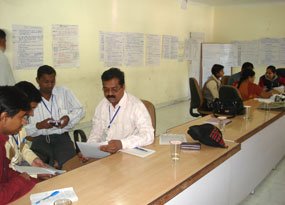
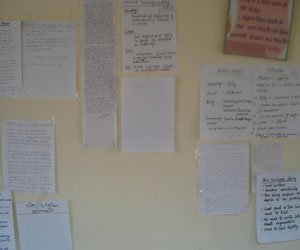
All participants wrote the stories and displayed them on the walls of the conference room. Some of the stories were read and analysed. This exercise provided opportunity to everyone of writing his/her story and read stories of others. Almost all the stories written had some mistakes, but it was fruitful for everyone to know the mistakes in his/her write up.
Techniques of Case Study Writing
The techniques of case study composition were discussed in detail with the demonstration of samples. The participants were given exercise of analysing the case studies too. Due to time constraints the participants could not do the field exercise for the same.
Publishing of Case Story
Many NGOs compose the case stories for using it in various forms. Publishing a case story is as important as documenting the case story. A number of ways and forms were told to the participants when they can publish their stories. Publishing tips were also shared.
DAY.4.SESSION – VII: (i) 9.30 am to 11.00 am (ii) 11.30 am to 3.00 pm
Techniques of Dissemination of Documented Information & Outreach Tools
Dissemination techniques were discussed in detail, apart from analysis of printed documents from communication point of view.
Overall Reflections & Closing
The participants gave their overall reflections on the training program on the last day. The program was closed with vote of thanks.
BRIEF PROFILE OF THE FACILITATORS
Mr. H. Arjjumend attained MSc from G. B. Pant University of Agri. & Tech. in Environmental Science, MRM from Indian Institute of Forest Management (Govt. of India) and few certificate courses from World Bank Institute, Human Rights Education Associates (USA), Green Net (Thailand), Mahidol University (Bangkok), Grolink (Sweden), World Bank Institute (USA) and Transcend University (Austria). He was Commonwealth Professional Fellow 2007 in Wolverhampton/London. Currently he is Social-Impact Fellow 2008-10. He has over 18 years experience of development action, research, documentation, training and advocacy. Previously he was Biologist at Wildlife Institute of India (Govt. of India), Research Officer at NCHSE, CCV Fellow of WWF-India, and Sr. Program Officer at PRIA. He taught at Masters level for about 3 years in MC National University of Journalism, Bhopal. He founded People’s Resource Centre, a consultancy and publication group, in 1999, and served as Consultant to large number of NGOs, support agencies and donors. He is principal co-founder of Grassroots India Trust. He has supervised about 25 study projects and produced over 30 research/discussion papers and technical reports. He is engaged in several social enterprises. He is Managing Trustee and Executive Director of Grassroots India Trust, and leading all other institutions of Grassroots Group including Grassroots Institute. He has conducted/supervised over 28 studies and has got over 35 publications of varied types in his credit.
|
Ms. Pallavi Upadhyaya has a Masters degree in Public Policy from ICFAI Hyderabad and has done B.Com (Hons) from Shri Ram College of Commerce, Delhi University. She brings with her project management experience in the NGO sector and the ability to successfully work at the grassroots as well as ensure smooth functioning of projects by working closely with key stakeholders. She has worked on programs for girls’ education and also has experience of working in an international setting during her tenure as a supervisor for an International Youth Exchange program. During her various assignments, she has extensively worked on training, documentation as well as monitoring and evaluation of development projects. She has documented annual reports, training modules and survey reports. Her paper on Gender Budgeting was selected for presentation at an international women’s conference, “Women’s World 2008-09” in Madrid, Spain. She is a Guest Faculty to conduct training at Grassroots Institute.
|
The training was coordinated by young old man, Mr. Chuni Lal, who graduated from H. P. University. After serving in army for 22 years, he established models of sustainable agriculture on his lands. Being a progressive and technologically-appropriate farmer, he received a number of prizes from HP Agriculture University and Department of Agriculture. He co-founded Institute of Resource & Environmental Management (IREM). He attained large number of trainings from Indian Institute of Forest Management, H.P. Agriculture University, Y.S. Parmar University of Horticulture & Forestry, H.P. Department of Agriculture, Navdanya, Nirantar, Grassroots Institute, HPMC, H.P. Health Department, and so on. He is presently leading a grassroots movement of conserving the agro-biodiversity in situ and popularizing the organic farming practices among the peasants of Western Himalayas. Apart from a leader of garlic cooperatives in Seraj Valley, he is known social worker in Kullu district. He is currently the Head of Regional Operations of Grassroots India Trust. He is also one of the Trustees of Grassroots India Trust.
 |
 |
|
| |
| |
 |
Mr. Pagano Didla
Executive Director
Socio-Economic Educational Development
Society (SEEDS)
ELURU, W. G. Distt. (AP) |
| |
|
|
| |
 |
Mr. Govardhan Paratpara Rao Yarlagadda
Executive Secretary
Socio-Economic Educational Development Society (SEEDS)
ELURU, W. G. Distt. (AP) |
| |
|
| |
The process documentation I learnt is the process planned and extended step by step. After the training everybody can do the documentation in the field. Best thing in the training was the explanation on ‘what’, ‘why’ and ‘how’ the documentation. Merits and demerits of the documentation as elaborated are useful. Tools explained are important to know. I could know the case story in real NGO context. The group discussions and participatory method was useful to develop the knowledge. |
| |
|
| |
 |
Mr. Sailesh Kumar Singh
Director
Raigarh Sahayog Samiti
Raigarh (CG) |
| |
|
| |
A good training program with lot of learnings in a fully participatory approach I never seen before. Resource Persons facilitated to have good understanding of the subject. Duration was sufficient. Material distributed is quite useful. Lodging and boarding arrangements were fantastic. |
| |
|
| |
 |
Ms. Aditi Sahay
Associate Coordinator Communications
Pravah
New Delhi |
| |
|
| |
I really enjoyed the training. It helped me understand the nuances of process documentation and also widened my sphere of knowledge. The exercises were well designed and helped sharpen my analysis of documented data. I really feel that I can apply the learning from this training in my field of works.
The facilitators were good and responsive to all our queries. They were able to clearly explain concepts and elucidate their points effortlessly. |
| |
|
| |
 |
Mr. Sanjay Kumar
Director Operations
Aashray Adhikar Abhiyan (Action Aid)
Delhi |
| |
|
| |
Training was very fruitful for grassroots organizations though they don’t give emphasis on documentation. I understood sessions very well and rated it very high for emerging social activists. Techniques and tools are very scientific and good that we learnt. Arjjumend ji’s personal experience, sharing can be very helpful in terms of publishing. The training was designed very well; it’s just like a compact package within 4 days
|
| |
 |
|
| |
 |
Mr. Ahmed Mustafa Barbhuiya
Program Officer Communications
Confederation of Voluntary Associations (COVA)
Hyderabad (AP) |
| |
|
| |
It is really a nice experience on my part. The most important thing which I would like to comment is that the training was not a unidirectional teaching and learning process but a both way & crossway one. Apart from the designed and scheduled module of teaching, the experience which was shared from different angles and avenues was unique one. The Resource Persons were very experienced right from grassroots to the apex. |
| |
|
| |
 |
Ms. Seema Chhipa
Program Officer
Centre for Social Justice
Ahmedabad (Gujarat) |
| |
|
| |
Logistics was good.
Few participants derailed from the topic and hence consumed more time.
This training would be very helpful in writing case study.
Theory of process documentation was covered in depth.
Technology problem created disturbance in the beginning.. |
| |
|
| |
 |
Mr. Govind Narayan Vijay
Unit Head, Social Development
CECOEDECON
Jaipur (Rajasthan) |
| |
|
|
| |
 |
Mrs. Maheshwari
Vanangna
Chitrakoot (UP) |
| |
|
|
| |
 |
Ms. Sheela
Vanangna
Chitrakoot (UP) |
| |
|
|
| |
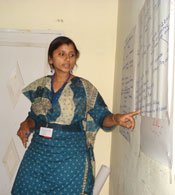 |
Ms. Srabani Dalal
Programme Officer (Capacity Building)
IFAD-DFID supported OTELP
ST & SC Development Department
Government of Orissa |
| |
|
| |
It was great learning through their training program. I got the meaning of process documentation, the procedures and the way of application while working in developmental sector. The exercises done during the training session were also really helpful to get in depth knowledge regarding different aspects of communication. The learning I got here will really be helpful for me while documenting. Thanks to the Grassroots.
The facilitators with their friendly manner and patience helped get the clear picture of process documentation during the training. Logistic arrangements were good. |
| |
|
| |
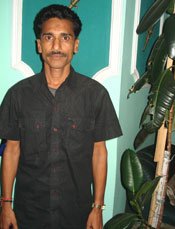 |
Mr. Debasis Jena
Programme Officer (Capacity Building)
IFAD-DFID supported OTELP
ST & SC Development Department
Government of Orissa |
| |
|
| |
The accommodation/ logistics was satisfactory. More kind of study materials like newsletter, success stories, case studies needed to be demonstrated during the training. The field visit and demonstration may have been incorporated.
Overall great thanks to the team who instituted the training from the side of Grassroots group. |
| |
|
| |
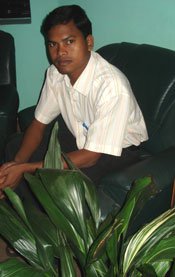 |
Mr. Saleem Gomango
Programme Officer (Capacity Building)
IFAD-DFID supported OTELP
ST & SC Development Department
Government of Orissa |
| |
|
| |
I learned from this training program about the process documentation: theory and practice, importance, characteristics of documentation specialist and importance of case story/study. The training was totally participatory. So I enjoyed all the parts of training program. I extend my heartily thanks to organizer and the supporter of the training program, also my PSU team who gave me the opportunity to attend the training program. |
| |
|
| |
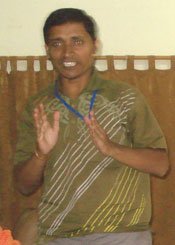 |
Mr. Suvendu Kumar Dhala
Programme Officer (Capacity Building)
IFAD-DFID supported OTELP
ST & SC Development Department
Government of Orissa |
| |
|
| |
The methodology for Process Documentation & Communication training was participatory where the participants were able to depict their views in most positive way.
Conceptual analysis and tools for process documentation was effective and relevant to our program at grassroots level. But there could be better learning if more tools & techniques, formats were to be discussed during first two days.
The case story and case study writing and its conceptual analysis were so effective that our learning will necessarily support in documenting our respective project |
| |
|
| |
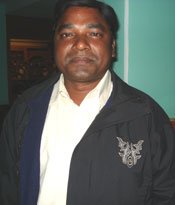 |
Mr. Eric Alfred Bakhala
Programme Officer (Capacity Building)
IFAD-DFID supported OTELP
ST & SC Development Department
Government of Orissa |
| |
|
| |
Logistic arrangement was excellent. Training sessions were brief and participatory as well as critical discussion was held on each subject. Power Point visuals were good. Group work and script writing in planning was nice.
|
| |
|
| |
 |
Mr. Pabitra Mohan Bara
Programme Officer (Capacity Building)
IFAD-DFID supported OTELP
ST & SC Development Department
Government of Orissa |
| |
|
| |
Logistic arrangements were good for stay as well as food. Participants should confine to the time set and be concise when sharing the experience. [His most of the comments written on piece of paper were not readable, so could not be included.]
My sincere thanks to the Resource persons for convening the capacity building on process documentation. It is good beginning by Grassroots Institute. We must work together. |
| |
|
| |
 |
Mr. Sanjeeb Kummar Sahu
Programme Officer (Capacity Building)
IFAD-DFID supported OTELP
ST & SC Development Department
Government of Orissa |
| |
|
| |
I am very much clear about the Process Documentation. It was very nice when we prepared the process document in practical. Now once I visit the filed and plan the process documentation it would give further clarity. The accommodation arrangements and the overall environment were very nice. I got more clarity on writing the case story and case study. All Resource Persons were very good and had patience for they gave time to us. Participants were also cooperative and nice.
|
| |
|
|
 |
|
|
 |
| |
| |
| |
Residential Trainings on
PROJECT
PLANNING & PROPOSAL WRITING
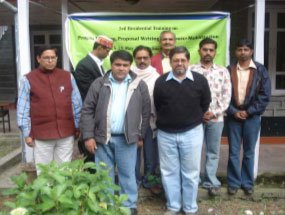
3rd Residential
Training on ‘Project Planning, Proposal Writing & Resource
Mobilization’
25-29 May 2007, Sai Ropa, Kullu
Project planning
is an essential step before submission of a written proposal to
an agency. Planning and writing of the proposals are critical components
of project management. Today perhaps there is no agency that does
not seek written proposal before sanctioning a project. Thus project
planning and proposal writing are extremely important for NGOs and
Government agencies that seek sponsorship, funding or just support
from national or international support agencies. The topics of deliberations
were: Steps of Project Planning; Preliminary Information Gathering;
Structure of Project Proposal: Discussion on Components; Techniques
of Writing of Various Components; Preparation of Budget; Essential
Precautions before Project Submission; Logical Framework Analysis;
Classification of Funding/ Donor Agencies; Ways of Long-Term Resource
Mobilization; Role of Dissemination, Publicity and Networking.
Resource
persons were: Mr. Hasrat Arjjumend and Dr. S. S. Samant, Scientist-in-Charge,
G. B. Pant Institute of Himalayan Environment & Development,
Kullu. The venue of the training was famous community education
center of Great Himalayan National Park. On 4th day, the participants
went on excursion into beautiful jungles of Great Himalayan National
Park. There was additional excursion to Manali organized on 30 May
2007. Society for Human Awareness & Rural Action (SHARA), Banjar
did all logistic and guiding arrangements during the training
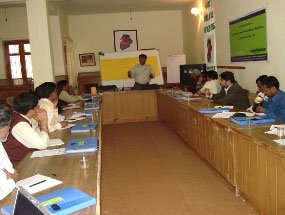 |
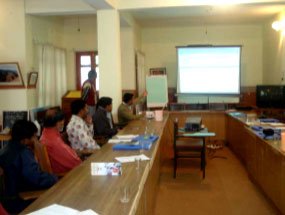 |
Participants
of the training came from different countries of South Asia: Pakistan,
Afghanistan, Nepal, Bangladesh and India. Indian states that represented
were Bihar, Jharkhand, Orissa, Delhi, Himachal Pradesh, Gujarat,
Maharashtra, Uttar Pradesh and Madhya Pradesh. One representative
of Indo-Global Social Service Society (IGSSS) also participated,
apart from a batch of participants sponsored by Water Aid India.
In total, 20 people attended the training.
----------------------------------------------------------------------------------------------------------------------------------------------------------------- |
Residential
Trainings on PROCESS DOCUMENTATION & COMMUNICATION
|
|
| Brief
Report of
VIth Residential Training on PROCESS
DOCUMENTATION & COMMUNICATION
26-30
June 2008 || Shimla |
VIth
batch of the training received overwhelming response from all
over India and Nepal. We had 25 seats when we announced the training.
But seeing the pressure of applications and insistence of some
of them we had to increase the seats to 32. But at the last moment
we were forced by one additional candidate to make the figure
33. A sizeable number of applications were declined due to over-packing
of the available places. It also created problems in terms of
available vacancies in the Parimahal campus of Shimla where the
accommodation arrangements were already tight.
Summer
always remains a peak season in Shimla. This puts further pressure
on available venues of Shimla. The booking in Parimahal was cancelled
thrice as a result of mounted pressure from political lobbies
who sought the booking on same dates. The warden of Parimahal
campus somehow managed the accommodation for the trainees amid
tremendous political pressure. Ultimately, the training could
be organized at the same venue.
All
33 participants joined the training who came from DFID-supported
Community Support Program (Nepal), CARE India (CG), Sakthi-Vidiyal
(Madurai), Aagaz Foundation (New Delhi), Navajeevan Bala Bhavan
(Vijaywada), Forum for Child Rights (Vijaywada), PRAYASAM (Kolkata),
United Mission to Nepal (Kathmandu), Upward Bound Program (Patna),
M. V. Foundation (Secunderabad), Action India (New Delhi), White
Lotus Trust (New Delhi), Abhivyakti Media for Development (Nashik)
and couple of other organizations. 17 participants joined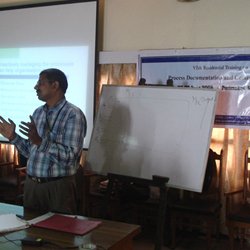 from first two organizations. Majority of the participants took
active part in the training and hence learnt adequately from different
sessions. Several participants, however, were found negative due
to their pre-determined mind of touring Shimla and surroundings.
from first two organizations. Majority of the participants took
active part in the training and hence learnt adequately from different
sessions. Several participants, however, were found negative due
to their pre-determined mind of touring Shimla and surroundings.
Brief
profile of the facilitators is mentioned as under:
Mr. Milind Saxena
is a development professional having more than 16 years of working
experience with renowned organizations like Water & Sanitation
Program – South Asia, UNICEF, NIPFP, IEG, DFID-PACS, IDS-Knowledge
Link Research Project, Water Aid, etc. He possesses an MPhil degree
in Social Medicine and Community Health from Jawaharlal Nehru
University. His areas of expertise are health economics, environmental
policy, water & sanitation, knowledge management. He is known
consultant in the field of water and sanitation.
|
Dr.
M. Aslam Ansari holds Post-Doctorate in Mass Communication
from Centre for Mass Communication Research, University of Leicester,
England; Doctorate in Extension Education from IVRI, Izatnagar,
and Post graduation in Agriculture Communication & Extension from G.B.
Pant University of Agri. & Tech. Pantnagar (UK). He has about
20 years experience of working in Corporate sector (Mudra Communications,
Bangalore/ MICA), Government sector (U.P. Academy of Administration,
Nainital), NGO sector (Prerana Population Resource Centre, Lucknow)
and Academic sector (Lucknow University; Allahabad Agriculture Institute
Deemed University, Allahabad; and G. B. Pant University, Pantnagar).
He has about 50 publications in national and international journals
of repute. Currently, he is Associate Professor of Agriculture Communication
at G. B. Pant University of Agriculture & Technology. He has
delievered large number of trainings to government officers including
IAS, IPS and PCS cadres, to managers of development agencies and
NGOs, and field workers of health projects. He was core resource
person for SIPFSA/ USAID. He is also the Trustee of Grassroots India
Trust.
graduation in Agriculture Communication & Extension from G.B.
Pant University of Agri. & Tech. Pantnagar (UK). He has about
20 years experience of working in Corporate sector (Mudra Communications,
Bangalore/ MICA), Government sector (U.P. Academy of Administration,
Nainital), NGO sector (Prerana Population Resource Centre, Lucknow)
and Academic sector (Lucknow University; Allahabad Agriculture Institute
Deemed University, Allahabad; and G. B. Pant University, Pantnagar).
He has about 50 publications in national and international journals
of repute. Currently, he is Associate Professor of Agriculture Communication
at G. B. Pant University of Agriculture & Technology. He has
delievered large number of trainings to government officers including
IAS, IPS and PCS cadres, to managers of development agencies and
NGOs, and field workers of health projects. He was core resource
person for SIPFSA/ USAID. He is also the Trustee of Grassroots India
Trust.
|
Mr.
H. Arjjumend attained MSc from G. B. Pant University of
Agri. & Tech. in Environmental Science, MRM from Indian Institute
of Forest Management (Govt. of India) and few certificate courses
from World Bank Institute,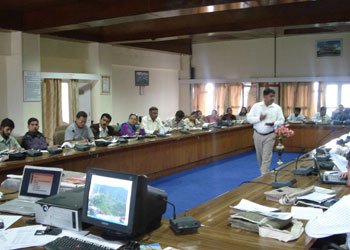 Human Rights Education Associates (USA), Green Net (Thailand), Grolink
(Sweden) and Transcend University (Belgium). He was Commonwealth
Professional Fellow 2007 in Wolverhampton/ London. Currently he
is Social-Impact Fellow. He has over 16 years experience
of development action, research, documentation and media writing.
Previously he was Biologist at Wildlife Institute of India (Govt.
of India), Research Officer at NCHSE, CCV Fellow of WWF-India, and
Sr. Program Officer at PRIA. He taught at Masters level for about
3 years in MC National University of Journalism, Bhopal. He founded
People’s Resource Centre, a consultancy and publication group,
in 1999, and served as Consultant to large number of NGOs, support
agencies and donors. He is principal co-founder of Grassroots India
Trust. He has supervised about 25 study projects and produced over
30 research/discussion papers and technical reports. He is engaged
in several social enterprises. He is Managing Trustee and Executive
Director of Grassroots India Trust, and leading the establishment
process of all other institutions of Grassroots Group including
Grassroots Institute.
Human Rights Education Associates (USA), Green Net (Thailand), Grolink
(Sweden) and Transcend University (Belgium). He was Commonwealth
Professional Fellow 2007 in Wolverhampton/ London. Currently he
is Social-Impact Fellow. He has over 16 years experience
of development action, research, documentation and media writing.
Previously he was Biologist at Wildlife Institute of India (Govt.
of India), Research Officer at NCHSE, CCV Fellow of WWF-India, and
Sr. Program Officer at PRIA. He taught at Masters level for about
3 years in MC National University of Journalism, Bhopal. He founded
People’s Resource Centre, a consultancy and publication group,
in 1999, and served as Consultant to large number of NGOs, support
agencies and donors. He is principal co-founder of Grassroots India
Trust. He has supervised about 25 study projects and produced over
30 research/discussion papers and technical reports. He is engaged
in several social enterprises. He is Managing Trustee and Executive
Director of Grassroots India Trust, and leading the establishment
process of all other institutions of Grassroots Group including
Grassroots Institute.
|
Dr.
Amrit Varsha Gandhi is Senior Lecturer in the Department
of History at Post Graduate Centre, Himacha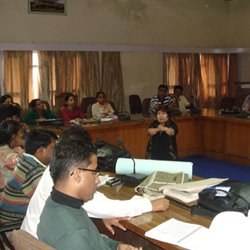 l
Pradesh University, Shimla. Prior to the teaching assignments she
worked as Research Officer in Research & Publications Division
at Nehru Memorial Museum & Library, Teen Murti House (New Delhi)
for about 15 years. She was associated with the editing and publication
of historical documents so as to reach wide range of scholars interested
mainly on the period of Indian National movement. Some of the works
she was associated with include: Selected Works of Motilal Nehru
(7 volumes); Selected Works of Acharya Narendra Deva, (4 volumes
in English & 2 volumes in Hindi); Selected Works of Jaya Prakash
Narayan (3 volumes). Since then is engaged in research on modern
period of Indian History and contemporary issues. She has contributed
articles in Historical journals and presented papers at seminars/
workshops. Besides, her interest in women issues is kept alive by
engaging in research and awareness programmes organized by UGC and
various organizations. She is the executive member of the Centre
for Women’s Studies, Himachal Pradesh University, Shimla. l
Pradesh University, Shimla. Prior to the teaching assignments she
worked as Research Officer in Research & Publications Division
at Nehru Memorial Museum & Library, Teen Murti House (New Delhi)
for about 15 years. She was associated with the editing and publication
of historical documents so as to reach wide range of scholars interested
mainly on the period of Indian National movement. Some of the works
she was associated with include: Selected Works of Motilal Nehru
(7 volumes); Selected Works of Acharya Narendra Deva, (4 volumes
in English & 2 volumes in Hindi); Selected Works of Jaya Prakash
Narayan (3 volumes). Since then is engaged in research on modern
period of Indian History and contemporary issues. She has contributed
articles in Historical journals and presented papers at seminars/
workshops. Besides, her interest in women issues is kept alive by
engaging in research and awareness programmes organized by UGC and
various organizations. She is the executive member of the Centre
for Women’s Studies, Himachal Pradesh University, Shimla.
|
Mr.
Firoz Ahmad Firoz is interested in the everyday lives of
ordinary people and is active as social activist and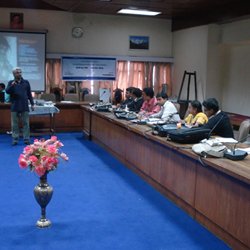 documentary photographer since 1986. He has worked for various organizations
such as UNESCO, UNICEF, VVGNLI, MoHRD, Lok Jumbish, NYKs, National
Social Watch Coalition, GCAP, UNMDG, ILO, and many more. He spent
5 years in Jawaharlal Nehru University, New Delhi where his
life transformed to be a photographer. JNU actually influenced him
greatly as an individual. He believes that there is always a typical
world in every picture, and the camera is a medium that teaches
him how to see the typical world. He is living in Delhi and founded
an NGO called “Social Geographic”. It’s focus
is on campaigning on social issues like female foeticide, gender
violence, poverty, child labour, dalits repression, etc. His some
pieces of work may be seen at: www.flickr.com/photos/social_geographic/
documentary photographer since 1986. He has worked for various organizations
such as UNESCO, UNICEF, VVGNLI, MoHRD, Lok Jumbish, NYKs, National
Social Watch Coalition, GCAP, UNMDG, ILO, and many more. He spent
5 years in Jawaharlal Nehru University, New Delhi where his
life transformed to be a photographer. JNU actually influenced him
greatly as an individual. He believes that there is always a typical
world in every picture, and the camera is a medium that teaches
him how to see the typical world. He is living in Delhi and founded
an NGO called “Social Geographic”. It’s focus
is on campaigning on social issues like female foeticide, gender
violence, poverty, child labour, dalits repression, etc. His some
pieces of work may be seen at: www.flickr.com/photos/social_geographic/
|
The
training was coordinated by young old man, Mr. Chuni Lal,
who graduated from H. P. University. After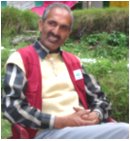 serving in army for 22 years, he established models of sustainable
agriculture on his lands. Being a progressive and technologically-appropriate
farmer, he received a number of prizes from HP Agriculture University
and Department of Agriculture. He co-founded Institute of Resource
& Environmental Management (IREM). He attained large number
of trainings from Indian Institute of Forest Management, H.P. Agriculture
University, Y.S. Parmar University of Horticulture & Forestry,
H.P. Department of Agriculture, Navdanya, Nirantar, Grassroots Institute,
HPMC, H.P. Health Department, and so on. He is presently leading
a grassroots movement of conserving the agro-biodiversity in situ
and popularizing the organic farming practices among the peasants
of Western Himalayas. Apart from a leader of garlic cooperatives
in Seraj Valley, he is known social worker in Kullu district. He
is currently the Head of Regional Operations of Grassroots India
Trust. He is also one of the Trustees of Grassroots India Trust.
serving in army for 22 years, he established models of sustainable
agriculture on his lands. Being a progressive and technologically-appropriate
farmer, he received a number of prizes from HP Agriculture University
and Department of Agriculture. He co-founded Institute of Resource
& Environmental Management (IREM). He attained large number
of trainings from Indian Institute of Forest Management, H.P. Agriculture
University, Y.S. Parmar University of Horticulture & Forestry,
H.P. Department of Agriculture, Navdanya, Nirantar, Grassroots Institute,
HPMC, H.P. Health Department, and so on. He is presently leading
a grassroots movement of conserving the agro-biodiversity in situ
and popularizing the organic farming practices among the peasants
of Western Himalayas. Apart from a leader of garlic cooperatives
in Seraj Valley, he is known social worker in Kullu district. He
is currently the Head of Regional Operations of Grassroots India
Trust. He is also one of the Trustees of Grassroots India Trust.
|
| LIST
OF PARTICIPANTS |
Dr. G. Sharmila Jim, B.S.M &.S, M.Sc, M.Phil :: 11
years experience
Project Director, Sakthi – Vidiyal, Madurai
Ms.
Indira Pancholi, MPhil :: 23 years experience
Sr. Programme Officer, Aagaz Foundation, New Delhi
Ms.
Anusha Bharadwaj, B Tech, MBA :: 3 years experience
Project Coordinator, M.V. Foundation, Secunderabad
Mr.
Amlan Ganguly, BA, LLB :: 10 years experience
Secretary, PRAYASAM, Kolkata
Mr.
Anand, MSW :: 7 years experience
Project Officer, Navajeevan Bala Bhavan, Vijayawada
Ms.
Virangana Rani
Project Desk In-Charge, Forum for Child Rights, Vijayawada
Mr.
Md. Talha, MA
Manager, Upward Bound Program, Patna
Mr.
Keshav Duwadi, BL :: 8 years experience
Children at Risk Adviser, United Mission to Nepal, Kathmandu
Mr.
Ganesh Mandekar, MSW :: 12 years experience
Coordinator, Abhivyakti Media for Development, Nashik
Mr.
Suraj Kumar, BA, MCA :: 7 years experience
Coordinator, White Lotus Trust, New Delhi
Ms.
Priyanka Singh, BA, PGDHR :: 4 years experience
Project Officer, Action India, New Delhi
Mr.
Bam Bahadur Khadka, BA :: 17 years experience
District Programme Officer, DFID–CSP, Nepal
Mr.
Raju Ram Tirwa, MA
District Programme Officer, DFID–CSP, Nepal
Mr.
Padam Bahadur Bishwakarma, MA :: 9 years experience
District Programme Officer, DFID–CSP, Nepal
Ms.
Shubha Devi B. K, ISc :: 15 years experience
District Programme Officer, DFID–CSP, Nepal
Mr.
Kamal Kumar Darlami Magar, Dip. CE :: 5 years experience
Over Seer, DFID–CSP, Nepal
Mr.
Rohit Kumar Odari, MSc :: 16 years experience
M & E Specialist, DFID–CSP, Nepal
Mr.
Bhuwan Singh Sejuwal, MA :: 14 years experience
District Programme Officer, DFID–CSP, Nepal
Mr.
Youb Raj Basnet, Graduate :: 13 years experience
Finance & Administrative Officer, DFID–CSP, Nepal
Mr.
Keshav Prasad Shrestha, MBA, BL :: 20 years experience
Head of Finance & Administration, DFID–CSP, Nepal
Mr.
Mahesh Kumar Shahi, MA :: 5 years experience
District Programme Officer, DFID–CSP, Nepal
Mr.
Anurag K Srivastava, MA, PGDip :: 8 years experience
Regional Manager, CARE India, Lucknow
Mr.
Deepak S. Hate, BSc :: 25 years experience
Replication Support Officer, INHP, CARE India, Chhattisgarh
Mr.
Naresh Ramnani, MA, MPhil, DPharma
Program Officer, INHP, CARE India, Chhattisgarh
Mr.
Raj Kumar Rai, BA, LLB, MSW :: 18 years experience
Replication Support Officer, INHP, CARE India, Chhattisgarh
Mr.
Dilip A Kawade, MSW :: 21 years experience
Program Officer, INHP, CARE India, Chhattisgarh
Ms.
Harshita Pandey, MA, MSW :: 9 years experience
Program Officer, INHP, CARE India, Chhattisgarh
Mr.
Reji S Kuruvilla, BSc, MSW :: 13 years experience
Program Officer, INHP, CARE India, Chhattisgarh
Mrs.
Nazma Sultana, MCom :: 20 years experience
Finance Manager, NR International Ltd., Bhubaneswar
Mrs.
Suchitra Pradhan, MA :: 15 years experience
Social Coordinator, NR International Ltd., Bhubaneswar
|
-----------------------------------------------------------------------------------------------------------------------------------------------------------------
Glimpses of Vth Residential Training on PROCESS DOCUMENTATION
& COMMUNICATION
held at Bajaura,
Kullu (HP) on 22-26 April 2008
Participants of Vth Batch
1. Mr. O. P.
Mishra, Agriculture Finance Corporation Ltd., New Delhi
2. Ms. Rama Gupta, Plan International, New Delhi
3. Mr. Saurabh Rai, Azim Premji Foundation, Dehradun (Uttarakhand)
4. Mr. Man Mohan Singh, All India Samaj Sewa Kendra, Yamuna Nagar
(Haryana)
5. Dr. N. P. Baduni, Agriculture Finance Corporation Ltd., Dehradun
(Uttarakhand)
6. Mr. Dawa Zangpo, RNR-RC (Ministry of Agriculture), Bhutan
7. Mr. Sangay Wangdi, RNR-RC (Ministry of Agriculture), Bhutan
8. Dr. Lalit Kumar Das, Vector Control Research Centre (ICMR), Pondicherry
9. Mr. Ramjee Rai, Grameen Development Services, Muzaffarpur (Bihar)
10. Mr. Ghanshyam Mishra, Grameen Development Services, Maharajganj
(UP)
11. Mr. Jitendra Kumar Singh, GPSVS, Madhubani (Bihar)
12. Mr. Satyendra Prasad, Nav Jagriti, Patna (Bihar)
13. Mr. Pratap Kumar Mohanty, VASUNDHARA, Bhubaneswar (Orissa)
14. Mr. Dhruv Kumar, Panchsheel Development Trust, Bahraich (UP)
15. Mr. Shiv Bhushan Srivastava, DISA, Basti (UP)
16. Ms. Sabita Singh, VASUNDHARA, Bhubaneswar (Orissa)
17. Ms. Raadia Mukadam, Karnataka Health Promotion Trust, Bangalore
(Karnataka)
18. Mr. Ankush Mote, YUVA: Youth For Unity & Voluntary Action,
Nagpur (MH)
19. Ms. Shamim Bano, CREDA, Mirzapur (UP)
20. Mr. Md. Rafique, State Health Resource Centre, Raipur (CG)
21. Mr. Hemant Vaishnav, State Health Resource Centre, Raipur (CG)
22. Mr. Rakesh Kumar Singh, Yuva Chetna Kendra, Deoria (UP)
23. Mr. Kushal Ram Ghosle, State Health Resource Centre, Raipur
(CG)
24. Mr. Mukesh Kumar Dewangan, State Health Resource Centre, Raipur
(CG)
25. Ms. Anupama Rana, Mahila Chetna Manch, Bhopal (MP)
26. Mr. Rajesh Kumar Agrawal, C.G. Tribal Development Programme,
Raipur (CG)
27. Mr. Ashutosh Awasthi, Sitapur (UP)
28. Ms. Sandhya Tamrakar, C.G. Tribal Development Programme, Raipur
(CG)
29. Dr. Yuvaraj J., Vector Control Research Centre (ICMR), Pondicherry
[dropped on last moment]
30. Mr. C. B. Rai, RNR-RC (Ministry of Agriculture), Bhutan [dropped
on last moment]
-----------------------------------------------------------------------------------------------------------------------------------------------------------------
Report of IVth Training 2007 || Varanasi
A
5-day training, organized jointly Grassroots Institute and Grassroots
India Trust, was held at Parshawnath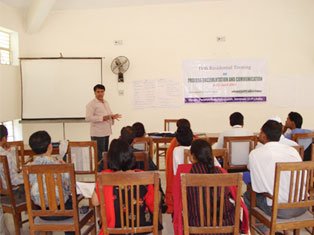 Vidyapeeth (an affiliated research centre of Banaras Hindu University).
In the training important topics taught were: Process Documentation:
Theory & Practice; What should be documented and why; Types
of Documents and Reports of NGOs/Development Projects; General Techniques
of Documentation and Communication; Techniques of Writing Quarterly/
Annual Progress Report of a Project/ Organization; Techniques of
Writing Annual Report of Organization; Techniques of Writing Study
Reports; Techniques of Preparation of Leaflet/ Folder of Organization;
Techniques of Good Presentation of Documents/ Reports; Demonstration
of Making Good Documents on Computer; Power Point Presentations;
Photography and Photo Documentation; Video Documentation: Steps
of Pre-Production, Production and Post-Production Phases; Importance
of Case Story in Process Documentation; Difference between Case
Story and Case Study; Techniques of Case Story Writing; Photo Presentation
with Case Story; Outreach Tools;
Vidyapeeth (an affiliated research centre of Banaras Hindu University).
In the training important topics taught were: Process Documentation:
Theory & Practice; What should be documented and why; Types
of Documents and Reports of NGOs/Development Projects; General Techniques
of Documentation and Communication; Techniques of Writing Quarterly/
Annual Progress Report of a Project/ Organization; Techniques of
Writing Annual Report of Organization; Techniques of Writing Study
Reports; Techniques of Preparation of Leaflet/ Folder of Organization;
Techniques of Good Presentation of Documents/ Reports; Demonstration
of Making Good Documents on Computer; Power Point Presentations;
Photography and Photo Documentation; Video Documentation: Steps
of Pre-Production, Production and Post-Production Phases; Importance
of Case Story in Process Documentation; Difference between Case
Story and Case Study; Techniques of Case Story Writing; Photo Presentation
with Case Story; Outreach Tools;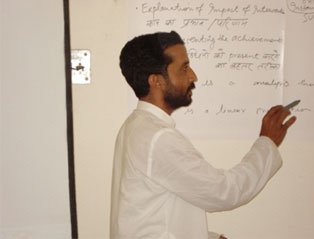 Techniques of Dissemination of Documented Information; and 20 Ways
of Communicating the Results/ Organization.
Techniques of Dissemination of Documented Information; and 20 Ways
of Communicating the Results/ Organization.
The participants came from the following organizations: ICIMOD,
Kathmandu; Guria, Varanasi; Gene Campaign, New Delhi; Akshay Pratishthan,
New Delhi; Adivasi Sevasharm Trust, Indore; SAATHI, Chennai; MITTRA,
Nasik; Centre for Environment Education, Lucknow; SHARA, Kullu;
PARA, Mandi; Navjyoti Development Society, Delhi; YASHADA, Pune;
CREATE, Lucknow; Nav Bhartiya Nari Vikas Samiti, Ballia. The training
was facilitated by Mr. Hasrat Arjjumend, Mr. Kamlesh and Mr. Ashendra
Singh. The feedback of the participants was very appreciating, as
they found the training useful, skill-enhancing and momentous.
|
|