GOVERNANCE & ACCOUNTABILITY PROGRAM
Governance
is crucial for delivery of development in the modern society.
Beginning from gram panchayats to parliament the governance system
is systematically failing to address the needs and aspirations
of poor and powerless people. Be an elected representative, executive
official or public leader, majority of those who govern the public
affairs, institutions, or structures remain unaccountable largely.
Inclusion of people at large fails to happen. Seeking accountabilities
of those who are in power and decision making capacities and striving
for inclusive governance are the principal activities of GIT under
this theme.
Current
Projects
Food and Democracy Campaign
 Food
and Democracy Campaign believes that ‘resources and means
of food
Food
and Democracy Campaign believes that ‘resources and means
of food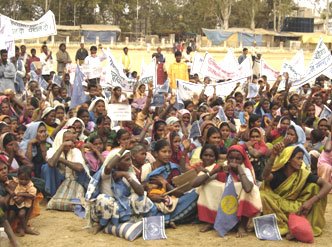 production’ are essential for food security in place of
being dependent on food aid. The hunger cannot be eliminated or
kept away unless the vulnerable families have equitable access
to ‘means and resources of food production’ and or
has ‘purchasing power’ to buy foods from market. Food
aid is a patchy solution. But, ironically, the ‘resource
and means of food production’ are being snatched away from
poor majority, and ability to assert one’s rights is increasingly
suppressed. Article-21b of the Constitution of India guarantees
food for life of every citizen of the country. In the rural areas,
the governments have been operating various schemes for food security
of rural poor. Yet, the problem of hunger and food scarcity is
multiplying day by day. Despite this fact, over 1.4 million villagers
in Sarguja district of Chhattisgarh struggle for their 2-times
bread every day. So in a bid to sensitize and hold accountable
the government and administration towards the hunger, malnutrition
and poverty of tribes and weaker sections in villages of Sarguja
district, the ‘Food and Democracy Campaign’ is co-organized
by Shri Gandhi Seva Ashram Sarguja (SGSA) and Grassroots India
Trust.
production’ are essential for food security in place of
being dependent on food aid. The hunger cannot be eliminated or
kept away unless the vulnerable families have equitable access
to ‘means and resources of food production’ and or
has ‘purchasing power’ to buy foods from market. Food
aid is a patchy solution. But, ironically, the ‘resource
and means of food production’ are being snatched away from
poor majority, and ability to assert one’s rights is increasingly
suppressed. Article-21b of the Constitution of India guarantees
food for life of every citizen of the country. In the rural areas,
the governments have been operating various schemes for food security
of rural poor. Yet, the problem of hunger and food scarcity is
multiplying day by day. Despite this fact, over 1.4 million villagers
in Sarguja district of Chhattisgarh struggle for their 2-times
bread every day. So in a bid to sensitize and hold accountable
the government and administration towards the hunger, malnutrition
and poverty of tribes and weaker sections in villages of Sarguja
district, the ‘Food and Democracy Campaign’ is co-organized
by Shri Gandhi Seva Ashram Sarguja (SGSA) and Grassroots India
Trust.
Local
Self-Governance
Participation
of marginalized communities especially women as voters in any
election process (including panchayat, legislative assembly and parliament) is completely
ill-informed. None knows about the past record of the contestants,
future prospects if voting to particular contestant, or alike.
Women cast their vote following the verdicts of the male leaders
locally or distantly who often have some alignment with the contestant.
Women really never raise questions about the credibility or the
prospective of voting to a particular contestant. This shows that
the leadership among women of marginalized rural communities (especially
Muslims and Dalits) is grossly suppressed by their counterparts.
So in nutshell the women have no informed choices and participation
in the local self-governance system and the election process.
This project addresses this fundamental issue.
panchayat, legislative assembly and parliament) is completely
ill-informed. None knows about the past record of the contestants,
future prospects if voting to particular contestant, or alike.
Women cast their vote following the verdicts of the male leaders
locally or distantly who often have some alignment with the contestant.
Women really never raise questions about the credibility or the
prospective of voting to a particular contestant. This shows that
the leadership among women of marginalized rural communities (especially
Muslims and Dalits) is grossly suppressed by their counterparts.
So in nutshell the women have no informed choices and participation
in the local self-governance system and the election process.
This project addresses this fundamental issue.
The project
is in starting phase. A study is continuing in several villages
of Modinagar tehsil of Ghaziabad district in Uttar Pradesh since
February 2008. It is to understand the need of educating the women
about their powers (being a citizen or representative), the need
of participation in the governance system at all levels, roles
and responsibilities (being a citizen or representative), the
need and ways of leadership, the knowledge of women about political
parties, and awareness of women about election process. Based
on the findings of the study, a long-term strategy of interventions
will be prepared.
The project
has to be introduced in several districts of Uttar Pradesh.
For achievements of the project, please see Annual
Report.
For further information, please contact
the organization.
Additional
Proposed Projects |
•
|
Enhanced
participation of marginalized women in local self-governance
in Uttar Pradesh |
For further information on these proposed projects, please
see List of Projects OR
contact the organization.
|