HUMAN RIGHTS & SOCIAL JUSTICE PROGRAM
Violation
of human rights undermines the ability of human being to access
development and social justice. The violators of human rights
range from powerful and feudalistic communities and individuals
to state agencies and settlers. Dalits of Himalayas have worse
status of their human rights, as no socio-political empowerment
has taken place. They have been historically deprived, marginalized
and excluded as a result of unjust caste system. Tribes of Santal
Parganas in Jharkhand have lost their lands – the basis
of survival – to massive alienation of tribal lands by non-tribal
settlers. Grassroots India has initiated interventions at local
level in Himachal Pradesh and Jharkhand to address the issues
of local communities.
Current
Projects
Dalit Rights & Empowerment
Dalits in
Himalayas especially in Himachal Pradesh and Uttaranchal have
socially, economically and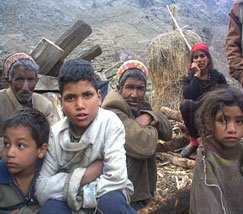 environmentally deprived for time immemorial. There is sheer discrimination
against them manifested in forms of untouchability. They cannot
enter the houses of upper castes, nor they are given food in common
utensils. Drinking water sources and temples/deities are also
separate. Villages or habitations of dalits exist more on south-facing
slopes, on wastelands, or surrounded by scarce natural resources.
On the contrary, upper castes villages mostly enjoy plenty of
natural resources including water and biomass. Dalit families
have scanty landholdings. For centuries, dalit community in mountains
has silently accepted subjugation avoiding any violent conflict
(inter-community). Social deprivation is coupled with economic
and social injustice. Majority of the families usually depend
on NTFPs collection for bare survival. Women usually face brunt
of the violation of human rights by the upper strata people. They
are also often exploited physically and economically. Such situations
are fierce and grievous in interiors of mountains where GIT has
been implementing dalits empowerment activities. There is a identified
need to alter the power relations in the society, which is only
possible through organizing and empowering the suffering community.
environmentally deprived for time immemorial. There is sheer discrimination
against them manifested in forms of untouchability. They cannot
enter the houses of upper castes, nor they are given food in common
utensils. Drinking water sources and temples/deities are also
separate. Villages or habitations of dalits exist more on south-facing
slopes, on wastelands, or surrounded by scarce natural resources.
On the contrary, upper castes villages mostly enjoy plenty of
natural resources including water and biomass. Dalit families
have scanty landholdings. For centuries, dalit community in mountains
has silently accepted subjugation avoiding any violent conflict
(inter-community). Social deprivation is coupled with economic
and social injustice. Majority of the families usually depend
on NTFPs collection for bare survival. Women usually face brunt
of the violation of human rights by the upper strata people. They
are also often exploited physically and economically. Such situations
are fierce and grievous in interiors of mountains where GIT has
been implementing dalits empowerment activities. There is a identified
need to alter the power relations in the society, which is only
possible through organizing and empowering the suffering community.
To change
the power relations in society of mountains, the planned and strategic
interventions are undertaken at local level. There are identified
four areas of interventions: (i) organization and leadership,
(ii) rights education, (iii) social empowerment, and (iv) improvement
of economics of families.
The project
is currently operational in several panchayats of Kullu district
with future possibility of expansion in Mandi, Kangra and Chamba
districts of Himachal Pradesh.
For achievements of the project, please see Annual
Report.
For further information, please contact
the organization.
Tribal
Land Rights
Land is life for the tribes. But the land is becoming scarcer
to the tribes day by day as it is alienated by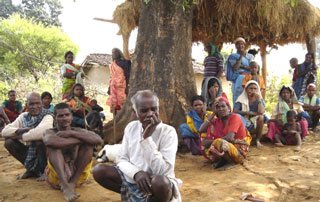 settlers and powerful co-existing communities or acquired in the
wake of globalization by the government and corporations. Santal
Parganas of Jharkhand is inhabited majorly by Santal and Paharia
tribes. The non-tribal settlers and immigrants, industries and
urban agglomerations have taken away the lands of tribes massively.
As a result thousands of tribal families have become landless
and live without any base of livelihood. Protecting tribal lives
and livelihoods by litigating to liberate the lands is the action
of urgent attention. GIT has tied up with a local tribal organization,
Santal Education Trust, in Santal Parganas of Jharkhand.
settlers and powerful co-existing communities or acquired in the
wake of globalization by the government and corporations. Santal
Parganas of Jharkhand is inhabited majorly by Santal and Paharia
tribes. The non-tribal settlers and immigrants, industries and
urban agglomerations have taken away the lands of tribes massively.
As a result thousands of tribal families have become landless
and live without any base of livelihood. Protecting tribal lives
and livelihoods by litigating to liberate the lands is the action
of urgent attention. GIT has tied up with a local tribal organization,
Santal Education Trust, in Santal Parganas of Jharkhand.
The project
is currently operational in Santal Parganas region of Jharkhand.
For achievements of the project, please see Annual
Report.
For further information, please contact
the organization.
Additional
Proposed Projects |
•
|
Rights
livelihood approaches of development consisting of policy
analysis and advocacy (Central India) |
For further information on these proposed projects, please
see List of Projects OR
contact the organization.
|
.