Sustainable Agriculture Development
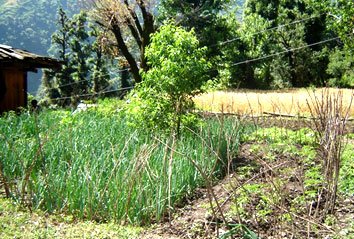
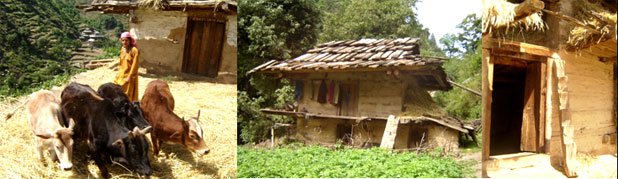
The use of chemical inputs on a large scale in Kullu district has a variety of negative effects. Chemical fertilizers are destroying the soil structure with evidence 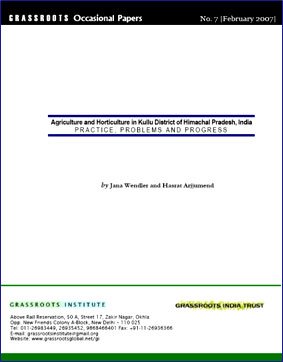 of declining productivity, increasing health risks, loss of biodiversity on-farm, reducing food security and overall environmental damage in mountain agro-ecosystems. Monoculture is gradually taking over, which is obviously disastrous in the long-term. For example, garlic has been taking over the cereal and staple crops. T he farmers who have been using chemicals for over a decade now look for alternatives of chemicals. Besides, other set of farmers want improvement of productivity of traditional cultivars they have been growing for years. The project, therefore, addresses the need of farmers to get rid of chemicals and increase productivity of diverse traditional cultivars of the crops. GIT and SHARA launched activities promoting the �sustainable agriculture development' in the hills of Kullu district of Himachal Pradesh. of declining productivity, increasing health risks, loss of biodiversity on-farm, reducing food security and overall environmental damage in mountain agro-ecosystems. Monoculture is gradually taking over, which is obviously disastrous in the long-term. For example, garlic has been taking over the cereal and staple crops. T he farmers who have been using chemicals for over a decade now look for alternatives of chemicals. Besides, other set of farmers want improvement of productivity of traditional cultivars they have been growing for years. The project, therefore, addresses the need of farmers to get rid of chemicals and increase productivity of diverse traditional cultivars of the crops. GIT and SHARA launched activities promoting the �sustainable agriculture development' in the hills of Kullu district of Himachal Pradesh.
Achievements } }
• To assess the agricultural and horticultural situations in Kullu district, the GIT/SHARA first commissioned a short study. A graduate researcher from Oxford University , Ms. Jana Wendler, studied the status of agriculture and horticulture including traditional farming practices in Kullu district. GIT published her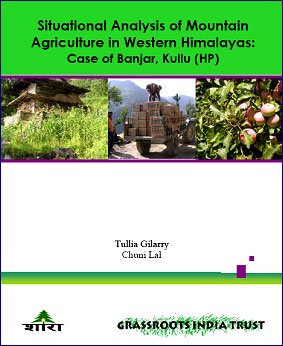 report as Occasional Paper No. 7 entitling �Agriculture and Horticulture in Kullu District of Himachal Pradesh: Practice, Problems and Progress�, which includes some very interesting findings. This paper is also available in e-library of Asia-Pacific Mountain Forum (APMN). The study guided organization's further action on sustaining the agricultural practices in mountains of Kullu. report as Occasional Paper No. 7 entitling �Agriculture and Horticulture in Kullu District of Himachal Pradesh: Practice, Problems and Progress�, which includes some very interesting findings. This paper is also available in e-library of Asia-Pacific Mountain Forum (APMN). The study guided organization's further action on sustaining the agricultural practices in mountains of Kullu.
• Training imparted to farmers form the main component of promotion of sustainable agriculture. 150 farmers of 9 villages were trained on organic farming methods, bio-fertilizers and bio-pesticides by organizing 12 major trainings at 7 different places.
• An agro-biodiverse farm has been developed in 9 acres at Kalwari village. This farm is established for the purpose of extension and education of farmers. The farmers do get exposure to this demonstrable model of sustainable agriculture.
• Situation analysis of mountain agriculture has been performed by an Australian intern, Ms. Tullia Gilarry, and Mr. Chuni Lal, Regional Manager-HP of GIT. They analyzed the agricultural production systems, market, economy and government support available. Findings of this report will be used in strengthening the sustainable agriculture in the mountains.
Microcredit & Micro-Entrepreneurship for Sustainable Livelihoods
The microcredit is the main tool, which is being used by the communities to improve their economic situation and alleviate the poverty. SHARA organized the women in the mountain villages of Banjar tehsil of Kullu district in Himachal Pradesh. Grassroots India Trust ( GIT) started supporting the microcredit activities in early 2006 only. SHARA/GIT actually had started an institutionalization process in the villages. Under institutionalization the women addressed their impoverishment on priority and came forward to act for livelihoods development so that their economic empowerment can take place along with social upliftment. To achieve the results the SHARA/GIT went through a cumbersome process of bringing people together. After initial meetings with the women in each village, several workshops had been organized. In the interactive workshops, the following problems were identified and discussed: 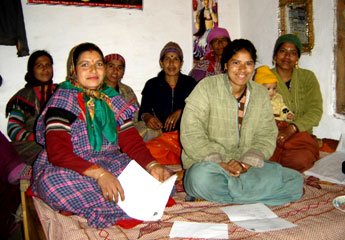
• ? Disparity in economic status of families;
• Lack of self-reliance;
• Disinterest in democratic system;
• Less mutual cooperation and coordination;
• Lack of proper information; and
• Rumors and misconceptions.
Achievements } }
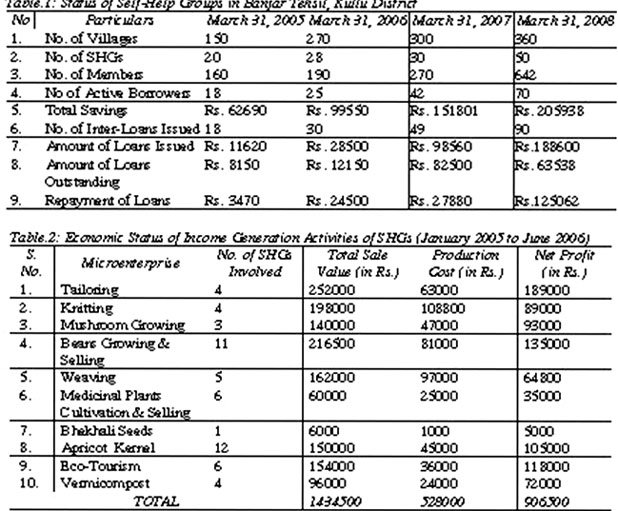
After perpetual efforts the SHARA/GIT succeeded in forming 50 SHGs in 360 villages. Some vital statistics showing the progress of SHGs is given in Table.1 below. |




















 degradation and decrease in food security, and limits nutritional availability. One of the main solutions to mitigate these risks would be to re-introduce traditional cultivars that are now rarely used, and to increase the number of cultivars on-farm. Traditional crops indigenous to the area are more ecologically adapted to local environmental conditions, so are less vulnerable to fluctuation and they have better resource efficiency than the HYVs. Increasing crop diversity will enhance food security, reduce farmer’s vulnerability to market uncertainties, and also preserve genetic resources for future generation. Moreover, intervention at the level of market of agro-biodiverse foods and elevated economic gains underlie the solutions of replacing or reducing chemical-intensive food production. Grassroots India Trust (GIT) partnered with SHARA to work on this project. The activities of the project include: