Studies & Reports
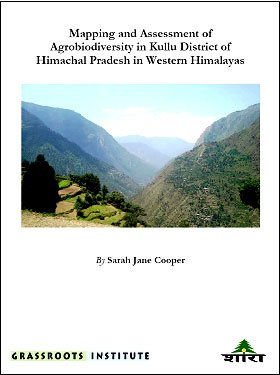
- Agricultural biodiversity is increasingly eroding, declining or disappearing. It is happening because of economic pressure on the traditional farmers, government’s support to modern agriculture, changing socio-cultural environment and disincentives for the farmers in the marketing of produce of the traditional crops. Hence the conservation and multiplication of traditional crops’ varieties/cultivars are extremely essential. Before actually starting the extension and promotion of agro-biodiversity conservation, it was essential to map and assess the agricultural biodiversity on-farm. A British national, Ms. Sarah Cooper was engaged to carry out the study “Mapping and Assessment of Agrobiodiversity in Kullu District of Himachal Pradesh in Western Himalayas”. She also carried out intensive documentation of traditional knowledge of the farmers in the villages where the critical varieties/ cultivars are in abundance or endangered. She produced a report entitling “Documentation of Traditional Agricultural Practices in Kullu District of Himachal Pradesh in Western Himalayas”.
- Grassroots Institute carried out an Impact Assessment Study of Integrated Women & Child Development Programme implemented by Delhi-based organization, the
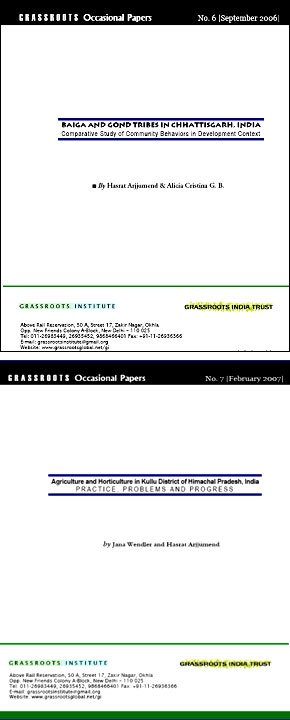 Women’s Action for Development (WAFD), in Bharatpur district of Rajasthan. The study addressed chiefly the girl child education and women empowerment. Poor and marginalized communities were in centre. The impact assessment study has explored the qualitative changes that have taken place in the target villages since 1998. The study was conducted between April and November 2006. Women’s Action for Development (WAFD), in Bharatpur district of Rajasthan. The study addressed chiefly the girl child education and women empowerment. Poor and marginalized communities were in centre. The impact assessment study has explored the qualitative changes that have taken place in the target villages since 1998. The study was conducted between April and November 2006.
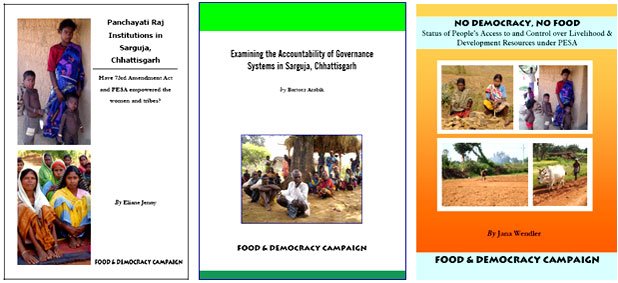
- Three studies were conduced by GIT’s Food & Democracy Campaign by involving three different foreign interns. The titles of their reports are: (1) No Food, No Democracy: Status of People’s Access to and Control over Livelihood and Development Resources under PESA; (2) Examining the Accountability of Governance Systems in Sarguja, Chhattisgarh; and (3) Panchayati Raj Institutions in Sarguja, Chhattisgarh: Have 73rd Amendment Act and PESA empowered the women and tribes?
- Survey and Documentation of Art & Craft in Western Himalayas: Since ancient times the techniques of handicrafts have been handed down from parents to children preserving the artisan families’ traditional ways and wisdom. The innate strengths of handicrafts have withstood the onslaught of mechanization and globalization. The mountainous state of Himachal Pradesh in the Western Himalayas can proudly boast being part of the sub-continent wherefrom the Indian civilization developed and proliferated to the Pan-Indian dimensions. It has generated a variety of paintings, wall paintings, jewellery, temples designs, wood carving on houses, music instruments, woolen clothes, which are still highly popular, both nationally and internationally. Moreover, the region is known for typical folk dances and songs also. Keeping this background in view, the SHARA and GIT have been doing documentation and survey on the rich heritage of a variety of arts and crafts prevalent in the Western Himalayas region of Himachal Pradesh (Kullu, Chamba, Kinnaur, Kangra districts). Sponsored by union Ministry of Culture, Govt. of India, the project has 3 members execution team.
Occasional Papers
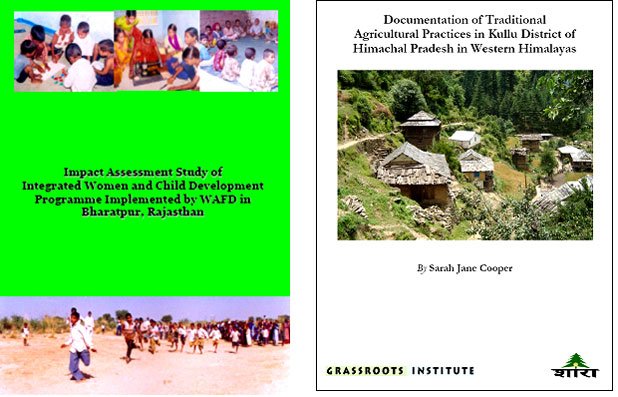
Two occasional papers had been published during the period of 2 years. They are:
- Baiga and Gond Tribes in Chhattisgarh, India: Comparative Study of Community Behaviour in Development Context, authored by Hasrat Arjjumend & Alicia Cristina G.B., No. 6 || September 2006 ||
- Agriculture and Horticulture in Kullu District of Himachal Pradesh, India: Practice, Problems and Progress, authored by Jana Wendlar & Hasrat Arjjumend, No. 7 || February 2007 ||
Newsletter
GIT and GMI have jointly published GRASSROOT COMMUNITY, a six-monthly newsletter. It contains several stories and the news based on the activities of GIT, GI and GMI. Till March 2008, only 2 issues could be published. 1000 copies of No.1, January 2007 issue contained the news from July 2006 to December 2006. On the other hand, 10,000 copies of No.2, July 2007 issue contained the news from January 2007 to June 2007. Issue No.3 and No.4 will be combined and published in July 2008. |