Achievements }}
- To percolate the whole Campaign at ground the Gram Shakti
 Sangathans (GSS) have been formed in 45 villages consisting of 1298 members. Sangathans (GSS) have been formed in 45 villages consisting of 1298 members.
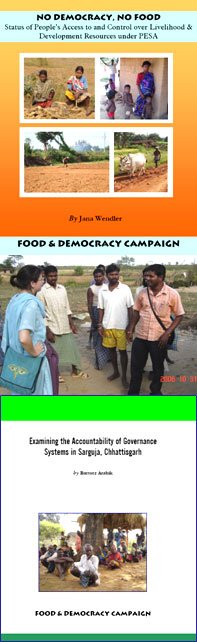
- An empirical study was commissioned to understand the Status of People’s Access to and Control over Livelihood & Development Resources under PESA in 7 villages of Sarguja district, which lies in 5th Schedule area. A German national who studied Politics, Philosophy and Economics at Oxford University, UK was engaged in the study from September 2006 till February 2007. She produced a wonderful report “No Food, No Democracy: Status of People’s Access to and Control over Livelihood & Development Resources under PESA”.
- Another study was carried out by engaging a Poland national who was educated at Johannes Kepler University at Linz, Austria and University of Wroclaw, Warsaw from October 2006 and to March 2007. He worked on understanding the macro issues of governance in context of people’s access to food and human rights. After studying he wrote a report “Examining the Accountability of Governance Systems in Sarguja, Chhattisgarh”.
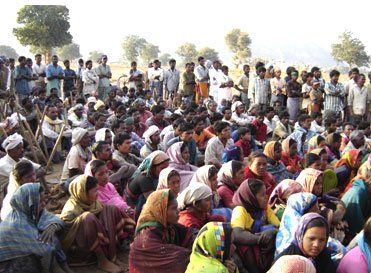
- About 5000 people gathered on 2 October 2006 in Ara-Balrampur village to observe Gram Swaraj Sammelan. The people criticized and demanded legal action against District Administration of Sarguja which illegally spent huge money of NREGA on planting over 0.9 million trees in 7 hours in a single day. It was all done to register in Limca Book of Records and earn the fame, but on the cost of public money which would otherwise have generated employment for thousands of families. The people also prepared new strategy of Food and Democracy Campaign for mass mobilization in villages of Sarguja. The whole area has been divided into 4 sectors in order to conduct rallies, demonstrations, foot marches, cycle rallies, wall writings, meetings, public meetings, dialogues, trainings, etc.
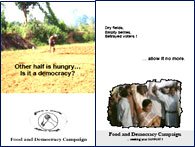
- Over 20 persons from rural areas of Sarguja had participated in World Social Forum – India on 9-13 November 2006 in New Delhi in a bid to raise their voices and echo their rights to food, dignity, and democratic governance. About 2000 copies of booklet “Other half is hungry” was distributed.
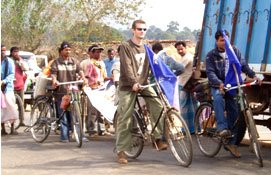
- A cycle rally was organized during 1-5 December 2006 from Aara Balrampur village of Rajpur block in Sarguja district. During 5
 days long journeys the Rally passed through 56 villages, and ended at Ambikapur, the district headquarters. Two groups consisting of 25 persons each moved on two separate routes. The issues that were raised by the rural people during the meetings in villages had been made public in Satyagrah Rally on World Human Rights Day (10 December 2006) at Ambikapur. days long journeys the Rally passed through 56 villages, and ended at Ambikapur, the district headquarters. Two groups consisting of 25 persons each moved on two separate routes. The issues that were raised by the rural people during the meetings in villages had been made public in Satyagrah Rally on World Human Rights Day (10 December 2006) at Ambikapur.
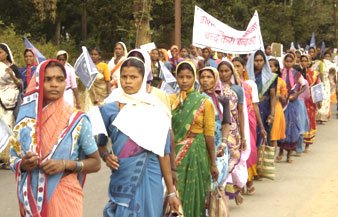
- On 10 December 2006, nearly 1000 people gathered in Ambikapur for a Satyagraha rally and mass demonstration on the occasion of World Human Rights Day. Marching from Sanjay Park to Vivekanand Chowk, the people expressed their discontent with the present situation regarding food and livelihood,
 and with the provisions from the government to solve these problems. Participants from all over Sarguja gathered for the event, most of them belonging to the most deprived parts of society such as adivasis, dalits and poor. All the issues addressed in the rally and the demands connected with them were collected in the Memorandum, which was submitted to the Honorable President of India. and with the provisions from the government to solve these problems. Participants from all over Sarguja gathered for the event, most of them belonging to the most deprived parts of society such as adivasis, dalits and poor. All the issues addressed in the rally and the demands connected with them were collected in the Memorandum, which was submitted to the Honorable President of India.
- Regional Consultation on People’s Rights to Food & Accountable Governance was organized on 3 February 2007 at Hotel Chidambara International, Raipur. In a bid to intensively focus on the issues concerning hunger, poverty and mis-governance, and to galvanize collective action in Chhattisgarh state and in neighboring central Indian states, the Regional Consultation was organized, with the following objectives:
- To debate the issues and concerns covered in Food and Democracy Campaign, and to share the findings of PDS, PESA and Accountabilities studies.
- To discuss intensively the issues, dimensions of problems, and policy updates and its implications on tribes, poor and marginalized.
- To discourse the collective ways of action on common areas of concern.
- To evolve the collective action strategies at state and regional level.
Retd. Justice of Calcutta High Court, Mr. S. K. Tiwary, inaugurated the Consultation. Ms. Jana Wendler, Mr. Bartosz Arabic and Mr. P. S. C. Rao presented their the situation analyses on food security. Several eminent speakers gave their deliberations on cross-cutting issues. They included: Keyur Bhushan, former MP and freedom fighter; Professor Balchandra Kachhwaha; Professor S. Trivedi, Mr. Basant Bhai, Mr. Aditya Patnaik, Ms. Shalini Samvedna, Mr. Jayant Verma, Ms. Sadhana Pathak, Mr. Lakhpat Singh, Mr. Yogesh Diwan, Mr. Menhdi Lal, Mr. Naresh Sharma, Ms. Hemlata Sahu, Mr. Sushil Sharma, Mr. Bhupesh Tiwari, Mr. Chunnilal Sharma. Participants represented various states of central India like Chhattisgarh, Madhya Pradesh, Orissa, Andhra Pradesh, Jharkhand, Maharashtra and Bihar. Almost 100 people took part in the program. Civil Society magazine of Delhi sent a reporter to cover the program.
- On 10 December 2007, a huge number of villagers from Sarguja district gathered in Ambikapur mass demonstration on the occasion of World Human Rights Day. They apart from rally in the city presented a Memorandum to Governor, Chief Minister and President of India. This time each person brought handful of rice and collected together. Later small packets of rice were sent to selected ministers and other high profile people as the people’s contribution towards food security in the country. This was an innovative method of assertion.
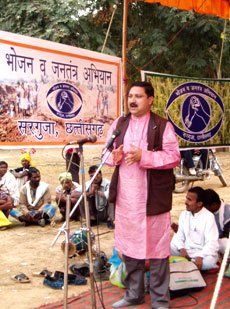
- A 3-day training on ‘Leadership for Non-Violent Movement’ and 5-day training on ‘Legal Literacy and Campaigning Skills’ was organized in Ara-Balrampur and Ambikapur, respectively, in December 2007 and January 2008. The trainings were meant for the leaders of Gram Shakti Sangathans, the community groups. Over 25 and 40 participants, respectively, learnt and exercised in both the trainings.
- To look into the situations of women in local self-governance in 5th Schedule Area, a study was commissioned in Sarguja district. A Swiss national, Ms. Eliane Jenny, who was MA in Social Anthropology from University of Zurich, was engaged. She found that many elected women representatives feel ashamed to raise their voice in the meetings of panchayat bodies. And if they speak, attention is often not paid to their voices and demands. Women also experience rejection and non-cooperation by their male counterparts. She recommended that there is a strong need to inform the women about the political institutions, processes and their political rights, to encourage them to actively participate in the political processes and institutions and to fight gender discriminating behaviour in the PRIs. Only then the women can exercise their political right and shape their economic and social development. Based on such observations in Sarguja district, the Food & Democracy Campaign has recently started discoursing researching and acting on ‘women and democracy’ aspects in context of food security.

Local Self-Governance
Participation of marginalized communities especially women as voters in any election process (including panchayat, legislative assembly and parliament) is completely ill-informed. It is the men who actually decide whom to vote. None knows about the past record of the contestants, future prospects if voting to particular contestant, or alike. Women cast their vote following the verdicts of the male leaders locally or distantly who often have some alignment with the contestant. Women really never raise questions about the credibility or the prospective of voting to a particular contestant. This shows that the leadership among women of marginalized rural communities (especially Muslims and Dalits) is grossly suppressed by their counterparts. So in nutshell the women have no informed choices and participation in the local self-governance system and the election process. This project has to address this fundamental issue.
Achievements }}
- A study is continuing in several villages of Modinagar tehsil of Ghaziabad district in Uttar Pradesh since February 2008. It is to understand the need of educating the women about their powers (being a citizen or representative), the need of participation in the governance system at all levels, roles and responsibilities (being a citizen or representative), the need and ways of leadership, the knowledge of women about political parties, and awareness of women about election process. Based on the findings of the study, a long-term strategy of interventions will be prepared.
Policy Advocacy
POST CARD CAMPAIGN for new National Rural Housing & Habitat Policy: BASIN, Development Alternatives, PACS and other partners had drafted new National Rural Housing & Habitat Policy 2007 with the assistance of UK’s DFID and Swiss Development Cooperation (SDC). In a bid to get this draft policy adopted by the Rural Development Ministry, the DA and PACS had engaged GIT to execute a postcard campaign in 20 provinces of India. 500,000 post cards had been printed and posted to rural areas through some local NGOs. The villagers from across the country had been mobilized to sign the postcards and send them to the Prime Minister of India. About 80,000 signed postcards returned back to the Prime Minister of India.
|




















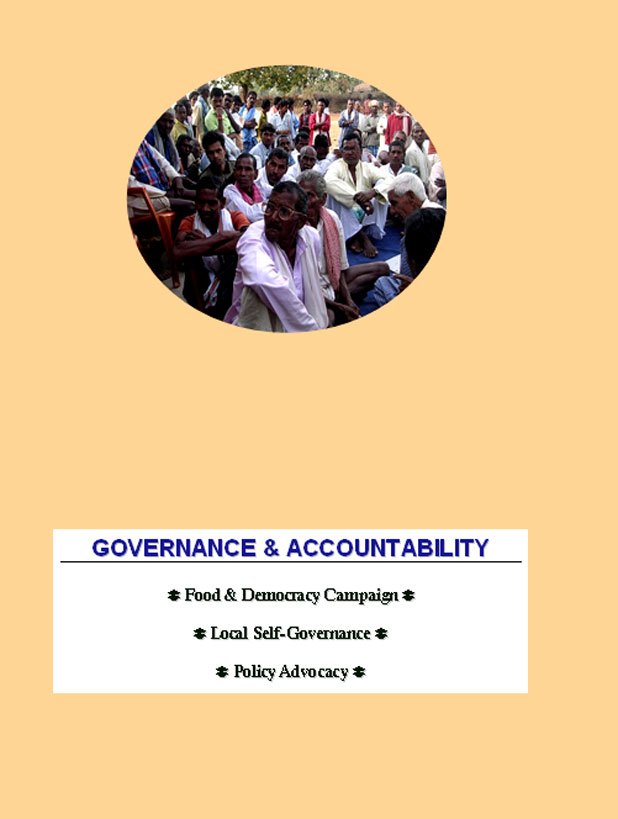
 Food and Democracy Campaign believes that ‘resources and means of food production’ are essential for food security in place of being dependent on food aid. The hunger cannot be eliminated or kept away unless the vulnerable families have
  equitable access to ‘means and resources of food production’ and or has ‘purchasing power’ to buy foods from market. Food aid is a patchy solution. But, ironically, the ‘resource and means of food production’ are being snatched away from poor majority, and ability to assert one’s rights is increasingly suppressed. Article-21b of the Constitution of India guarantees food for life of every citizen of the country. In the rural areas, the governments have been operating various schemes for food security of rural poor. Yet, the problem of hunger and food scarcity is multiplying day by day. Despite this fact, over 1.4 million villagers in Sarguja district of Chhattisgarh struggle for their 2-times bread every day. So in a bid to sensitize and hold accountable the government and administration towards the hunger, malnutrition and poverty of tribes and weaker sections in villages of Sarguja district, the ‘Food and Democracy Campaign’ is co-organized by Shri Gandhi Seva Ashram Sarguja (SGSA) and Grassroots India Trust.